

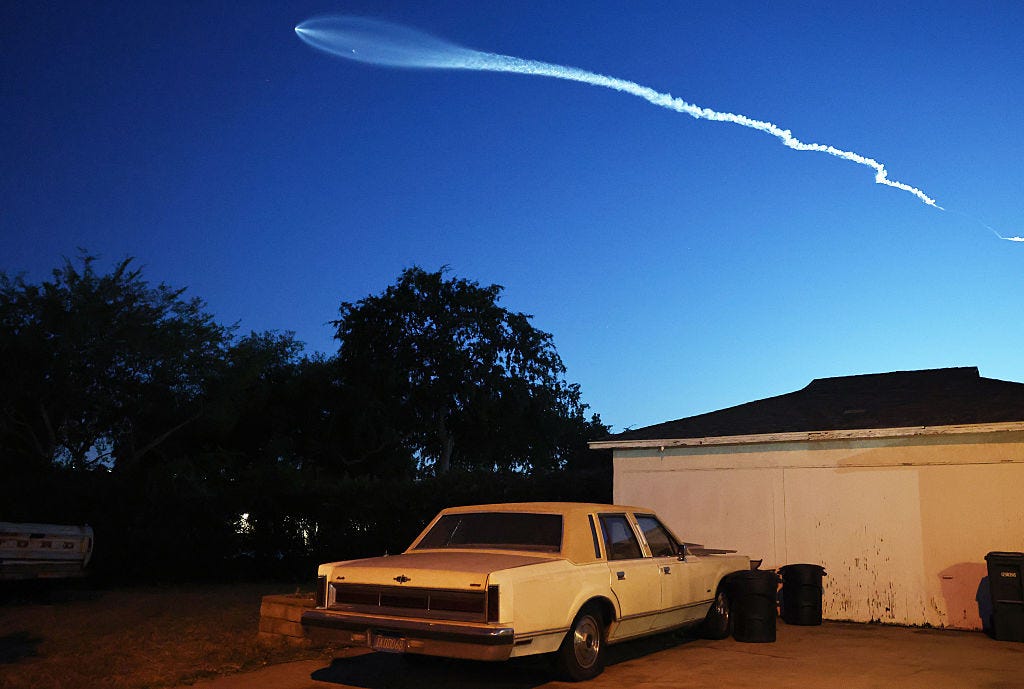
During a 2018 press conference at Kennedy Space Center, Elon Musk called for “a new space race,” one defined not by nations but by rival billionaires scrambling to commercialize and colonize the final frontier. Musk, the chief executive of SpaceX, has since launched thousands of satellites and hundreds of rockets. While his chief competitor in the race, Blue Origin founder Jeff Bezos, has had more modest success, the two centibillionaires’ companies recently filed to deploy roughly 1.1 million satellites combined into Earth’s orbit.
With the space economy projected to reach $1.8 trillion in value over the next decade, Musk and Bezos could become far wealthier. Their exploits could also lead to devastating environmental consequences, as metals from rockets and satellites burn up in Earth’s atmosphere at a growing, sustained rate.
In February, scientists in Germany and England published a novel study measuring a lithium plume from the uncontrolled re-entry of a SpaceX Falcon 9 rocket in the atmosphere above Western Europe. Their findings, which recorded a 10-fold increase in lithium in a portion of the atmosphere roughly 60 miles above Earth, raise fears about the long-term health of the ozone layer, which is vital for protecting the planet from the Sun’s ultraviolet radiation.
“One of the main concerns surrounding space-debris influx is the deposition of metals that may affect atmospheric chemistry, particularly aluminum because of its potential role in stratospheric ozone destruction,” Claudia Stolle, a professor at the Leibniz Institute of Atmospheric Physics, said in an interview. “We chose to measure lithium because it is an excellent tracer for lithium–aluminum alloys, which are widely used in modern rockets and satellites: when we detect lithium, it is likely that other re-entry-related elements are present as well.”
Stolle, who took part in the study, noted that changes in atmospheric chemistry resulting from rocket launches and satellite reentries are a significant scientific concern. “As space traffic increases, so does the amount of material being injected into the middle atmosphere through both launches and re-entries. We need to understand how these exotic elements, and the compounds they form, behave chemically once they are deposited at those altitudes,” she said, adding that exhaust from rockets poses another issue. “The rapid rise in launch activity means that we are not only seeing more re-entry material, but also more direct emissions from rocket engines.”
While the U.S. government oversees space travel and satellite spectrum licensing, there are no concrete national or international regulations governing atmospheric pollution from the space industry.
SpaceX and Blue Origin did not immediately respond to requests for comment.
“Stratospheric ozone destruction”
SpaceX has nearly 10,000 of its Starlink satellites operating in low Earth orbit, the region of space below an altitude of about 1200 miles. The constellation, which provides satellite internet to consumers and enterprise customers like United Airlines, is set to expand to roughly 40,000 units. Each satellite weighs between 500 and 2,760 pounds, with most of its material consisting of aluminum.
When a Starlink satellite reaches the end of its five-year lifespan, SpaceX uses onboard thrusters to bring it down into Earth’s upper atmosphere. There, the satellites are incinerated as they enter dense pockets of air at high speeds. Molten metals from the spacecraft, including aluminum, copper, and lithium, then appear in particle collections in the upper atmosphere.
This disposal method ensures that retired satellites are not left orbiting Earth in perpetuity, but it has also resulted in SpaceX burning up hundreds of tons of aluminum in the atmosphere since the first Starlink satellite was launched in 2019. Reentries are also becoming much more frequent as the constellation ages. Between December 2024 and November 2025, the company reported deorbiting 690 satellites, a number that far outpaced Starlink reentries from prior years.
Jonathan McDowell, an astronomer and astrophysicist who recently retired from the Harvard–Smithsonian Center for Astrophysics, noted in an interview that the increasing input of aluminum into the atmosphere from manmade sources now exceeds that from meteoritic sources. “For the first time, we are doing something to the upper atmosphere that nature hasn’t been doing,” he said. McDowell, who closely tracks and catalogs anthropogenic space debris, estimates that SpaceX burns up about one or two Starlink satellites in the atmosphere every day.
The immediate and long-term consequences of that much aluminum polluting Earth’s atmosphere are not fully understood, although there could be dangerous knock-on effects. “The main concerns are stratospheric ozone destruction, changes to radiative balance caused by aerosols, and possible impacts on upper atmosphere cloud formation and atmospheric composition,” said Stolle. “At this stage, we still cannot say with confidence how severe these effects may become. That will require several more years of targeted observations, laboratory work, and modeling.”
Rockets and satellites are also made up of more exotic metals than aluminum, including niobium and hafnium, which do not occur as free elements in nature. Those and other materials will require additional research. The Leibniz Institute of Atmospheric Physics is currently developing a new Multi-Species Lidar to measure a much broader range of metallic species and survey which elements are potentially being introduced into the upper atmosphere by re-entries.
But industry is moving much faster than science.
“We could be in trouble”
Over the last decade, Musk and Bezos have bitterly competed over aerospace technology patents and launch pad access from the U.S. Space Force. The two men are now attempting to outdo one another in dispatching networks of AI data centers in space.
In January, SpaceX filed a request with the Federal Communications Commission (FCC) to launch one million satellites in low Earth orbit to serve as AI data centers. At approximately 560 feet tall, based on scale illustrations, each satellite would be significantly larger than the International Space Station — and much more disposable, given how frequently data center chips must be replaced and upgraded.
Then, last month, Bezos’ Blue Origin asked the FCC for permission to launch an orbital data center network comprising more than 50,000 satellites. (Amazon, where Bezos serves as executive chairman, also plans to deploy thousands of traditional communications satellites.)
Launching orbital data centers at such a scale appears highly unlikely for the foreseeable future due to a combination of solar radiation, microgravity, and technological and financial constraints. The equity research firm MoffettNathanson estimated in February that SpaceX’s AI satellite concept would cost trillions of dollars. But Musk is nonetheless using the idea to increase investor interest in SpaceX ahead of its initial public offering this summer, when the company plans to raise $75 billion at a $1.75 trillion valuation. He has said that funds from SpaceX’s IPO will go toward executing his orbital data center vision.
The orbiting and deorbiting of so many satellites could lead to environmental problems, said McDowell, who coauthored a 2024 paper evaluating emissions from satellite launches and reentries. “If we up the ante from the 10,000 satellites we currently have to the million satellites that SpaceX are now talking about, we could be in trouble,” he said. “If you’re taking those million satellites and every five years or so, replacing them with a new lot, incinerating the first lot, that’s going to be a really major input to the atmospheric chemistry that we’re going to have to understand really well.”
Despite these pollution concerns, both Musk and Bezos’ Blue Origin have used eco-friendly talking points to promote their respective plans for orbital data centers. “Global electricity demand for AI simply cannot be met with terrestrial solutions, even in the near term, without imposing hardship on communities and the environment,” Musk wrote in February. Likewise, Blue Origin said in its recent FCC filing that orbital data centers would “ease mounting pressure on U.S. communities and natural resources by shifting energy-and water-intensive compute away from terrestrial data centers.”
They have to destroy the planet to force the human expansion to other planets where they will rule and democracy is non existent. Democracy is the checks and balances that keeps them from ruling as kings, even though they kinda already do because we all let them take over and buy their products and services as they fuck us over.
YES!