

Since assuming office again last year, Donald Trump has called for the arrest of Barack Obama, promised to annihilate a “whole civilization” during his war on Iran, and deployed federal shock troops at home to intimidate left-leaning cities, resulting in the murders of numerous Americans.
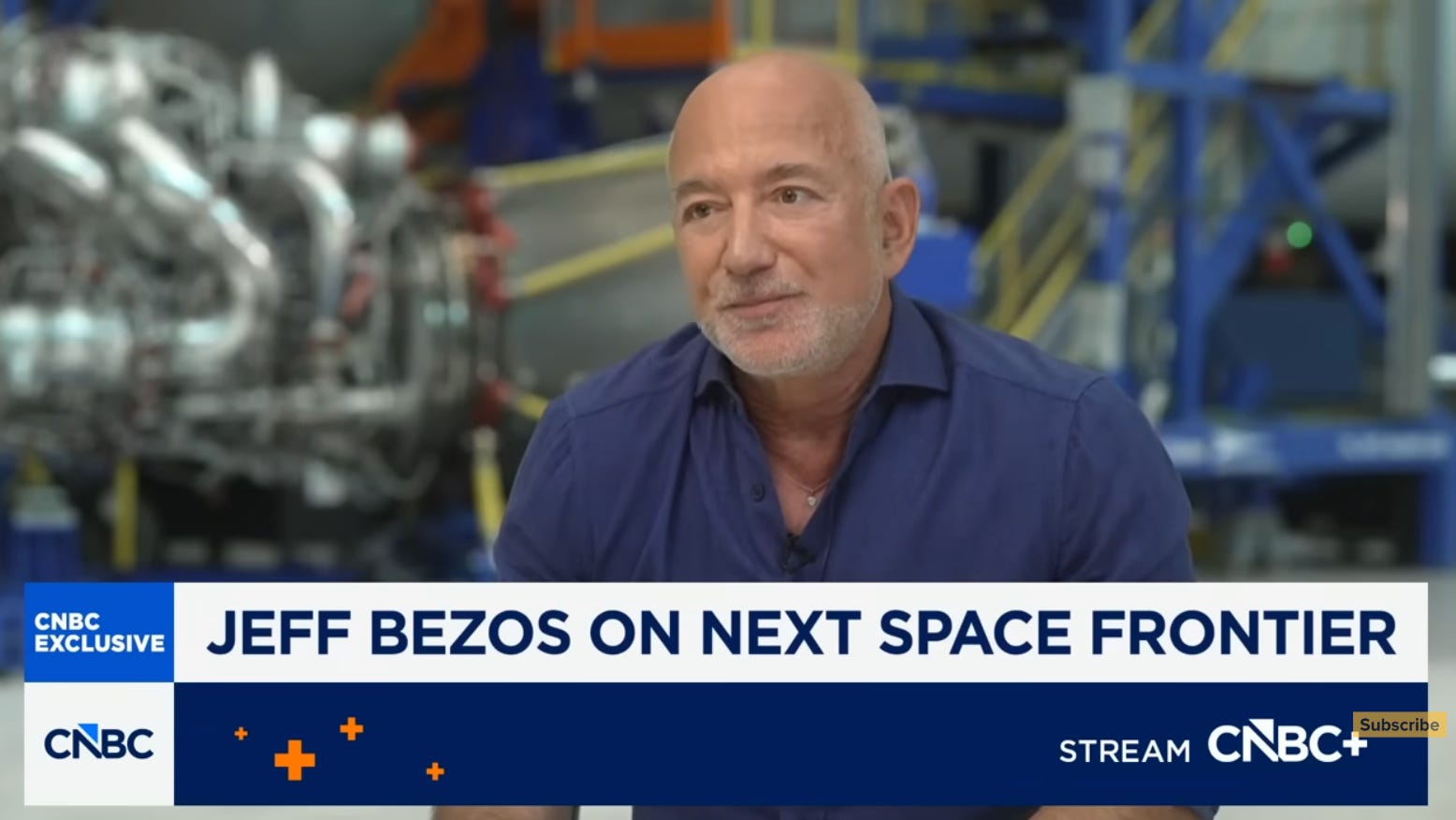
But to Jeff Bezos, Trump in his second term “is a more mature, more disciplined version of himself than he was in his first term.” The centibillionaire and executive chairman of Amazon, who made the comments during an interview with CNBC’s Andrew Ross Sorkin that aired on Wednesday, added that “Trump has lots of good ideas.”
“He’s been right about a lot of things,” he continued. “You have to give him credit where credit is due.”
Since relinquishing his role leading Amazon’s day-to-day operations in 2021, Bezos has placed more of his focus on Blue Origin, a rocket and space exploration company he founded in 2000. His rare interview with CNBC, for instance, was filmed at Blue Origin’s factory in Florida.
But the company has had little success compared to SpaceX, its top rival. To have any shot at catching up, Blue Origin will require a steady stream of government launch contracts. That dependency could explain Bezos’ newfound admiration for Trump, a man he previously accused of harboring a “personal vendetta” against him.
Bezos framed his relationship with Trump as something akin to a public service. “We need our business leaders to provide input into the administration, regardless of who the president is,” he said. “I’m on the side of America, and that is so important. Like, and that’s where business leaders should be… we get perceived as being like, you know, partisan or whatever. Like, I was helping Obama every chance I could. I was helping Biden every chance I could.”
Bezos went on to say he still calls “Obama for advice,” describing the former president as “a very smart guy.”
He also defended Amazon’s move to pay $40 million to buy the rights to Melania Trump’s hagiographic documentary, which many interpreted as a fairly direct attempt by Bezos to bribe the president. “The Melania thing is a falsehood that will not die,” he said. “Even though I had nothing to do with it, you know, it appears that the Amazon team made a very wise business decision.” The documentary almost certainly lost tens of millions of dollars.
At another point in the interview, he insisted that there is “no truth to this ‘buy, borrow, die’ thing,” referring to a tax avoidance strategy commonly used by the ultra wealthy, including Elon Musk and Larry Ellison. Bezos attempted to back his claim by saying he pays capital gains on Amazon shares that he offloads to fund his other businesses. He then added that fixing the “buy, borrow, die” loophole would not help a “nurse in Queens” making $75,000 a year.
To help that “nurse in Queens,” a hypothetical person whom Bezos referenced numerous times during the interview, the billionaire claimed he would “advocate” eliminating taxes for the bottom half of earners. “We shouldn’t be asking this nurse in Queens to send money to Washington,” he said. “They should be sending her an apology. It really makes no sense.”
Elon Musk applauded Bezos’ comments.


Jury rejects Musk’s case against Altman and OpenAI
A federal jury in California rejected Elon Musk’s $150 billion lawsuit against OpenAI and Sam Altman on Monday after less than two hours of deliberations.
The jury found that Musk filed his lawsuit after the three-year statute of limitations had expired. Musk’s claims, which included accusing Altman of enriching himself by “stealing a charity,” were subsequently dismissed by Judge Yvonne Gonzalez Rogers. (xAI, the chatbot developer owned by Musk, competes directly with OpenAI.)
On X, Musk vowed to appeal the decision. “The judge & jury never actually ruled on the merits of the case, just on a calendar technicality,” he wrote. In separate posts, he disparaged the presiding judge as a “terrible, activist Oakland judge, who simply used the jury as a fig leaf” and accused her of handing out “a free license to loot charities.”
OpenAI was launched as a nonprofit in 2015, with Musk and Altman serving as two of its cofounders. The lab created a for-profit subsidiary in 2019, a year after Musk stepped down from its board of directors. To raise additional funding, the ChatGPT-maker again overhauled its operating structure in 2025, spinning its for-profit wing into a public benefit corporation that is partially owned by the OpenAI Foundation.
On Wednesday, the New York Times reported that OpenAI “is preparing to file confidentially for an initial public offering in the coming weeks.”
SpaceX lost nearly $5 billion last year
That information was made public in SpaceX’s IPO prospectus, a regulatory disclosure it is required to file ahead of its planned listing on Nasdaq. “Our mission,” the company says, “is to build the systems and technologies necessary to make life multiplanetary, to understand the true nature of the universe, and to extend the light of consciousness to the stars.”
The company claims that its “current space efforts will catalyze transformative breakthroughs that could reshape terrestrial industries and lead to the emergence of new trillion-dollar markets on the Moon, Mars, and beyond.” It says that SpaceX has a “total addressable market” [TAM] of $28.5 trillion — which it describes as the largest TAM ever identified. Most of that market ($22.7 trillion), however, is not related to space exploration but AI “enterprise applications.”
Musk’s SpaceX pay package grants him an additional 1 billion shares if he establishes “a permanent human colony on Mars with at least one million inhabitants” and the company reaches a valuation of $7.5 trillion.
SpaceX’s recent performance is more earthly. The company lost about $5 billion in 2025 on annual revenue of $18.7 billion. In the first quarter of 2026, Space X lost another $4.3 billion. It recently merged with xAI, accelerating its cash burn significantly. Despite all of the red ink, SpaceX is projected to go public with a $1.75 trillion valuation as soon as June 12, per Reuters.
This Week in Musk:
A SpaceX contractor died from a fall last Friday at the company’s Starbase facility in South Texas. (Wall Street Journal)
Musk reportedly visited China last week in hopes of persuading the Chinese government to lift its export ban on solar manufacturing equipment that Tesla is looking to purchase. It’s unclear if his appeals worked, but SpaceX has new plans to build a giant solar factory in Bastrop, Texas, to help power Musk’s dreams of space-based data centers. (New York Times)
In recent posts, Musk has sought to damage Instagram’s brand reputation by suggesting that men who use the platform are feminine. “Sometimes grown men send me their Instagram profiles and I’m like are you transitioning or what?” he wrote last week in a post on X. “Instagram is for girls,” he added in a separate post. The sentiment appears to be an attempt by Musk, who owns X, to torpedo one of his platform’s top competitors. A Pew survey last year found that 50% of Americans report using Instagram, which was more than double the number who said they used X. (X)
Last year, Musk, then in charge of the Department of Government Efficiency, admitted that he “accidentally” canceled USAID’s “Ebola prevention” funding. Today, an Ebola outbreak has killed more than 130 people in the Democratic Republic of Congo. While Musk said that he “quickly” restored the canceled funding, the dismantling of USAID by DOGE and CDC funding cuts have hampered efforts to spot and contain the viral illness. (NPR)
$420
That’s how much xAI offered to pay employees and their family members in exchange for using their tax returns to train Grok, a large language model. But the Musk-owned company has failed to cough up the promised payouts. According to Bloomberg, “Some staffers who have asked about the payment have been told that the manager in charge of the program is no longer working there, people familiar with the matter said.”
Zuckerberg says Meta layoffs are necessary for AI development race
Meta CEO Mark Zuckerberg’s decision to lay off 10% of his company’s workforce, or 8,000 employees, began on Wednesday.
In an internal memo reported by the New York Times, the centibillionaire justified the move, writing that “success isn’t a given” in the technology race among leading AI companies. “A.I. is the most consequential technology of our lifetimes,” Zuckerberg wrote. “The companies that lead the way will define the next generation.” He also informed employees that he doesn’t plan to carry out additional “company-wide layoffs” for the rest of 2026, per Reuters.
Along with the layoffs, Meta, which owns Facebook, Instagram, and WhatsApp, moved to reassign 7,000 employees to four new AI divisions. The change marks a significant shift for a company that relies on digital advertising sales for nearly all of its revenue. Zuckerberg, however, believes that Meta’s future will be defined by its effort to develop “superintelligence.”
But many at the company are not supportive of the changes that Zuckerberg has made in pursuit of that goal. More than 1,000 employees have signed a petition calling for the end of a program that tracks nearly every action that Meta employees perform on their work computers, according to the New York Times. Meta is using data from its employee tracking program to train AI models that could one day replace human workers.
This Week in Zuck:
Zuckerberg, Elon Musk, and David Sacks each played a role in convincing the White House to delay an executive order on AI regulations that Donald Trump had planned to sign imminently. The order would have mandated a modicum of government oversight over the release of some new AI models. (Semafor)
Meta plans to spend $200 billion on a 4,000-acre AI data center in an impoverished area of Northeast Louisiana. The site will consume so much energy that a local utility company has agreed to build 10 new gas-fired plants to supply it. (Bloomberg)
The Senate Judiciary Committee has asked Zuckerberg to appear at a hearing next month focused on internet safety for children and whether social media is facing its “Big Tobacco” moment. Meta was recently held liable for failing to protect minors from sexual exploitation in New Mexico and for creating intentionally addictive features that harmed a young woman in California. (Roll Call)
To staff the beaches and pools at their $300 million estate in Hawaii, Zuckerberg and his wife are looking to hire a seasonal “beach water person.” (Wired)
“You shouldn’t worry about it”
That was the advice Jeff Bezos shared for those who might be concerned by the looming possibility of an AI bubble. On CNBC, he explained his lack of worry by insisting that “the bubble is driving investment and a lot of the investment is going to turn out to be very healthy.”
“Investors at this moment haven’t learned yet how to discriminate between good ideas and bad ideas, and that’s OK,” he added, “because the good ideas will pay for all of the losers.”
In 2026 alone, Amazon, Meta, Google, Microsoft, OpenAI, and Oracle are slated to collectively spend hundreds of billions of dollars on building AI infrastructure projects.
Former Google CEO booed for telling graduates that the future will be shaped by AI
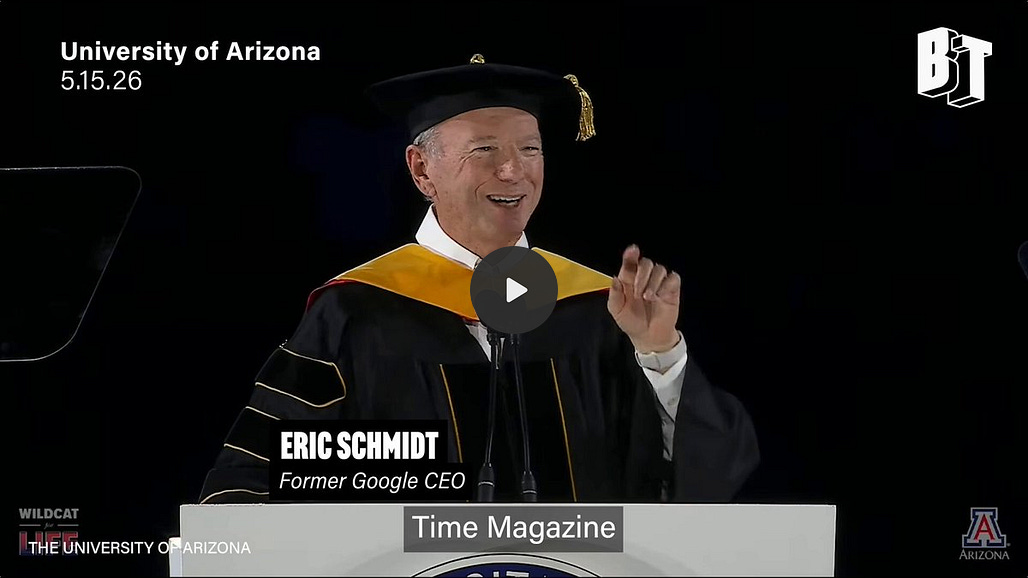
“There is a fear in your generation that the future has already been written, that the machines are coming, that the jobs are evaporating,” said former Google CEO Eric Schmidt while delivering a commencement address at the University of Arizona last week.
He then urged the graduating students to adapt to a future defined by artificial intelligence, saying, “AI will shape the world… The future is not yet finished. It is now your turn to shape it.”
Schmidt, who is worth an estimated $63 billion, was met with a chorus of jeers and boos every time he mentioned AI.

A poll conducted earlier this month by The Economist and YouGov found that 71% of Americans believe AI development is happening too rapidly. The survey also found that a majority of Americans are doubtful that the technology will yield economic gains that benefit everyone.
According to the Wall Street Journal, another recent poll from Stanford University and the University of California, Berkeley found that support for the technology is increasingly becoming a right-wing position. About 50% of Republicans said AI development should be accelerated as fast as possible, while just 30% of Democrats felt the same way.
Oligarch Roundup
Paramount chief David Ellison publicly backs Bari Weiss amid reports that she could lose top job at CBS News. “Bari has the full support of Paramount and David Ellison as the editorial leader overseeing CBS News and 60 Minutes. Reports suggesting otherwise are inaccurate,” said a Paramount spokesperson. Weiss, a right-wing opinion writer with no experience in broadcast news, was handpicked by Ellison — the son of centibillionaire Larry Ellison — last year to be the editor in chief of CBS News. During her tenure, Weiss has steered the network toward the right and appeared to demand editorial changes that were politically motivated. Numerous journalists have resigned in response. (The Guardian)
Paramount is considering buying a podcast hosted by Stephen Miller’s wife. The podcast, hosted by Katie Miller, who served in the first Trump administration and as a spokesperson for Elon Musk’s Department of Government Efficiency, has a relatively small audience. Paramount’s interest in purchasing the podcast appears to be yet another attempt by the Ellisons to curry favor with the Trump administration as they seek federal regulatory approval for their $111 billion acquisition of Warner Bros Discovery. (Axios)
James Murdoch agrees to buy New York Magazine, the Vox Media Podcast Network, and Vox.com for $300 million. James, the younger son of Fox News founder Rupert Murdoch, described the media properties as producers of “longer-form, thoughtful journalism that can really speak to the culture.” He was previously the chief executive of 21st Century Fox and the director of News Corp. But in 2024, his father had him removed from the family trust in favor of Lachlan, his older, more conservative brother. James has previously invested in the anti-Trump conservative news site the Bulwark. (New York Times)
Serious butt kissing
The world can do without the likes of Bozos