

How SpaceX crashed to earth
When it peaked in mid-June, Elon Musk’s net worth was valued at more than $1.3 trillion, making his individual wealth greater than the combined fortunes of Jeff Bezos, Mark Zuckerberg, Larry Page, Sergey Brin, Warren Buffett, and Bill Gates.
Musk marked the historic occasion by taking several victory laps on X, his social media platform. In the early hours of June 16, he shared a post from a user who insisted that anyone who is “mad” about his riches has “envy” and should “stop hating.” Musk then snarked about how quickly he would make his second trillion dollars.
But that was then. Over the last seven weeks, Musk’s fortune shrank by more than $550 billion following dramatic market losses suffered by Tesla, his automotive company, and SpaceX, his rocket, satellite, and artificial intelligence company.
Some investors, it seems, are growing wary of the science fiction-inspired dreams that Musk has spent years claiming are within reach.
A city on the Moon and a human colony on Mars. Extraterrestrial data centers longer than two football fields. Self-driving cars capable of replacing taxi drivers across America. Humanoid robots that can work production lines for corporations and babysit children.
These are a few of the goals that Musk, who remains the richest man in the world, has pitched while attempting to whip up investor excitement for Tesla and SpaceX.
His salesmanship proved especially effective in June, when SpaceX raised a record-setting $85.7 billion during its initial public offering — despite having just completed a three-month period in which the company lost more than $4 billion.
But the company has lost 23.6% of its value since its opening public price of $150 a share. At $114.53 as of market close on Monday, the stock had fallen by roughly 49% from its all-time high of $225.64.
The most immediate factor weighing on the stock is a looming lockup expiration, which could more than double the number of SpaceX shares available for public trading.
On Tuesday afternoon, SpaceX is set to report its first quarterly earnings as a listed company. Then, on Thursday, insiders and early investors will be allowed to sell up to 20% of locked-up stock — an infusion that is expected to drag the stock down further.
The company’s share price reached a record high, in part, because there were so few shares for the public to trade. Typically, when a company goes public, 20% or so of its total equity is made available. But in the case of SpaceX, less than 5% of its shares entered public circulation. While that scarcity initially helped drive demand, the company’s public shareholders are now days away from facing a potentially considerable supply problem.
The first lockup expiration is driving many investors to bet against SpaceX. According to S3 Partners and Bloomberg, short interest in the company has increased by more than 841%, rising from 23.3 million shares on June 16 to 219.3 million shares by July 29 — or more than one-third of all publicly available shares.
Another factor affecting SpaceX’s share price: a possible merger with Tesla. The Wall Street Journal reported last week that “some Tesla executives have been told to prepare for a separation of the China business ahead of a potential merger.” Musk called the report “fake news.”
The information landscape in the United States has reached a crisis point. Billionaires are using social media platforms and media outlets to advance their political and financial interests.
A Trump loyalist just seized control of CBS, CNN, and TikTok’s US operations.
Google paid Trump $25 million to settle a bogus lawsuit.
The Washington Post used editorials to advance the financial interests of owner Jeff Bezos
Meta CEO Mark Zuckerberg installed a Republican operative as head of policy
The only way to fight back is to build up independent media that is free from the influence of billionaires and corporate America.
Although Oligarch Watch has over 50,000 readers, only a small percentage support our work as paid subscribers. If you believe in independent journalism that holds the powerful to account, and can afford $7 a month or $60 per year, please consider becoming a paid subscriber.
“SpaceX will be worth more than the rest of Earth”
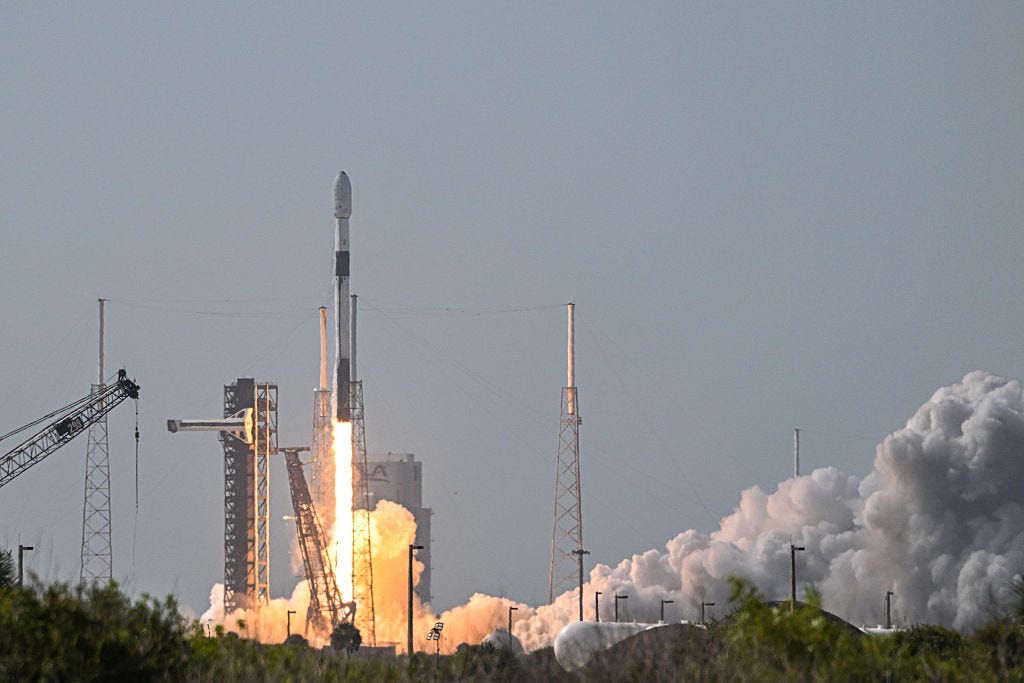
Apart from the lockup, SpaceX continues to encounter problems with Starship, the experimental two-stage, 396-foot-tall rocket that plays a central role in many of Musk’s most ambitious dreams. After three years of test launches, Starship continues to suffer failures while falling well short of Musk’s goal of a fully reusable launch system capable of hauling 150-ton payloads.
The company aborted a test launch in July due to numerous engine failures. A week later, when SpaceX resumed the test launch, the Starship’s Super Heavy booster experienced a failure for the second time in a row. The launch did succeed in deploying its payload of next-generation Starlink satellites. However, because Starship has yet to attempt orbital flight, the satellites were all incinerated in the atmosphere instead of being deployed in low-Earth orbit.
In the event that Starship does succeed, its profit potential could be limited by the relatively small addressable market for space launch services and competition from Jeff Bezos’ Blue Origin. Rather than fulfilling contract work, Starship’s primary function would likely be launching SpaceX’s expanding Starlink satellite constellation.
Musk, who recently predicted that SpaceX will one day “be worth more than the rest of Earth,” has said one of his big plans for Starship would involve placing massive AI data centers in low-Earth orbit. It’s unclear how he would protect the extremely costly and fragile computer chips from the harsh realities of cosmic radiation and microgravity, or how he would dissipate that much heat in a vacuum.
“We assign this scenario, in which both Starship is reusable and scaled orbital data centers are highly successful, a 7% chance of happening, which is one reason our final fair value estimate of $63 is much lower than $154,” Morningstar equity analyst Nicolas Owens wrote in June while making his bear case ahead of SpaceX’s IPO.
Musk’s long-held dream of ferrying humans to Mars is another task he has said Starship would fulfill. He claimed in 2011 that SpaceX would reach Mars within 10 years, according to the New York Times. He has since revised that prediction numerous times. “Starship departs for Mars at the end of next year, carrying Optimus,” he said in March of last year, adding that “human landings may start as soon as 2029, although 2031 is more likely.”
In the present, Starlink, the leading satellite internet provider, remains SpaceX’s only profit generator while its launch and AI divisions have posted billions in losses. But satellite internet is not a hugely profitable market. While the technology has important use cases — providing internet connectivity during natural disasters, aboard airplanes and ships, and to relatively wealthy customers living in rural regions — it remains inferior to terrestrial broadband in terms of network speeds, reliability, and costs.
The February merger of SpaceX and xAI, Musk’s artificial intelligence company that controls the X social media platform, represents another drag on the stock. After $6.4 billion in operating losses in 2025, xAI proceeded to burn $7.72 billion on capital expenditures in the first quarter of this year alone, or about 76% of SpaceX’s total capital expenditures.
Unlike Anthropic, OpenAI, and Google, xAI has not turned its spending frenzy into top-dollar contracts with corporate clients. But the lagging marketability of the Grok model has allowed SpaceX to sell excess computational power from its data centers to Anthropic, Google, and Reflection AI.
Having already completed two massive data centers in Memphis, Tennessee, xAI is now working on constructing two more in the area, despite opposition from residents suffering from air and noise pollution.
“The biggest product ever”
At Tesla, Musk’s gamble to turn the electric vehicle company into the leader in humanoid robotics and autonomous driving has not gone over well with investors.
Since reporting its latest quarterly earnings on July 22, Tesla stock has shed about 13.9% of its value, or roughly $205 billion in market capitalization. While car sales were up during the second quarter, the increase was driven by heavy discounting that eroded the company’s profit margins.
On the earnings call last month, Musk barely mentioned the company’s top-selling models. He instead turned almost all of his attention to Tesla’s dubious but costly AI ventures: its small Robotaxi test fleets and separate experimental Cybercab vehicle, the humanoid Optimus robot, and an AI chip manufacturing facility that will supposedly help power it all.
“We should be spending on [capital expenditures] as fast as we can without it being too wasteful,” he said, adding that Tesla was embarking on “the fastest industrial scale-up since World War II in America.”
Musk also attempted to explain why Tesla is constantly missing product deadlines and predictions that he himself has set.
He said Tesla’s Robotaxi ride-hailing project must be deployed slowly to avoid car accidents that might cause regulators to “immediately clamp down on our activities.”
Musk has spent the last 12 years predicting almost annually that Tesla would deliver full autonomy within one or two years. He has also repeatedly claimed that his company’s driver assistance systems save lives and are up to 10 times safer than having a human behind the wheel. However, his confidence in the safety of the systems has faded now that Tesla has been given the freedom to test and expand its Robotaxi service in numerous large cities.
As for the development of Tesla’s humanoid robot, Musk again promised investors that Optimus “will be the biggest product ever.” But he cautioned that Tesla was trying to solve something that “no one’s ever achieved,” including creating “superhuman dexterity” in a robot so versatile that it could learn tasks “if you simply ask it to do something or show it a video.”
“I really want to emphasize here that the production scaling challenge is very, very substantial,” he added. “This is going to be the hardest product to scale manufacturing that we’ve ever made at Tesla.”
Last year, Musk told investors that Tesla would produce up to 10,000 Optimus robots in 2025 alone. That promise never came to fruition.
glad things are not going well for Musk
I don’t believe Musk’s IQ is anything extraordinary, his EQ is in the single digits