

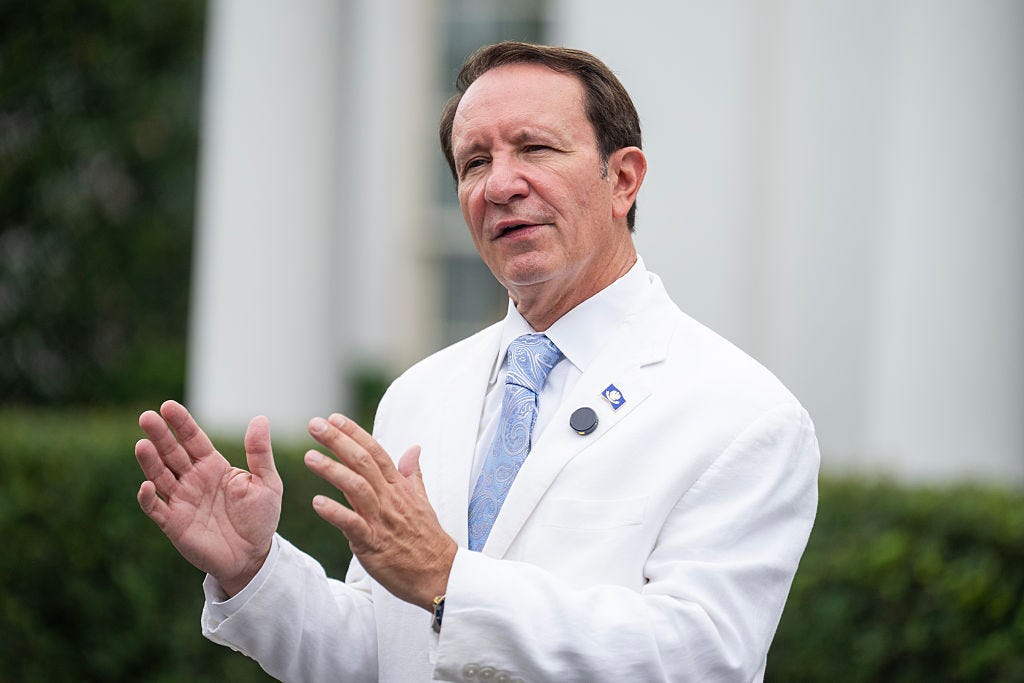
On Tuesday, Louisiana Governor Jeff Landry (R) announced an agreement allowing SpaceX to construct the world’s largest launch facility on top of a stretch of coastal wetlands that provide vital habitat for federally endangered and threatened species.
The deal — which will equip Elon Musk’s rocket and satellite company with another site from which to launch its gargantuan and explosive Starship rockets — marked the culmination of a regulatory coup in which state lawmakers and Trump officials have gone to great lengths to accommodate SpaceX by defanging environmental protections.
“Starbase Louisiana will ultimately have over a dozen launch towers, enabling more than 30 Starship flights per day and making it the biggest launch site on Earth!” Musk wrote on X.
The company’s unprecedented construction and launch plan has raised concerns among environmental and ecological experts.
“Those wetlands are so valuable, and they are free,” John Andrew Nyman, a professor at Louisiana State University and one of the leading authorities on the state’s wetlands, said in an interview.
“They were here to begin with. We didn’t have to pump them in to build them,” he added, referring to the billions that have been spent restoring a fraction of Louisiana’s lost wetland habitats. “Where is the effort to minimize the damage to them? And that’s just from the construction. What about the noise and the chemicals?”
Located near Pecan Island in southwest Louisiana, the land acquired by SpaceX is sandwiched between the state-managed Rockefeller Wildlife Refuge and a private Audubon Society sanctuary.
The sanctuary provides habitat for the federally endangered whooping crane and the threatened black rail and piping plover. Whooping cranes, a keystone species, have been slowly recovering since the 1930s, when hunting and habitat destruction had reduced the wild population to just 15 birds.
“Bird populations across the country are experiencing significant declines driven by habitat loss. Pecan Island provides vital habitat for huge numbers of migratory birds, including Endangered Whooping Cranes,” Michael J. Parr, president of the American Bird Conservancy, said in a statement to Oligarch Watch. Keeping major construction projects like SpaceX’s Louisiana development “out of this and other key habitats is critical to enabling populations to rebound,” he continued.
SpaceX purchased the 125,000-acre site from the Louisiana government for $100 million, according to the Times-Picayune/The New Orleans Advocate. The company’s president, Gwynne Shotwell, said SpaceX plans to invest $100 billion building “a small city” made up of a “self-sustaining spaceport with its own propellant production, power generation, deep water shipping capabilities, vehicle processing facilities, and probably an airport.”
Adding facilities in the state appears to be a major step toward Musk’s goal of launching more than 30 Starships every day by the end of the decade. The 408-foot-tall experimental rocket, which has yet to reach orbit, is the largest in aerospace history. With a booster stage capable of burning 7.5 million pounds of propellant in a single launch, Starship is also among the loudest and most explosive aerospace vehicles ever made.
The massive amounts of combustion, noise, and light pollution can be highly detrimental to local wildlife, as has been documented in coastal South Texas, where SpaceX has its only operational Starship launch site.
The launch cadence that Musk hopes to achieve could “certainly tip the scales for a species,” warned Brett Hartl, the government affairs director for the Center for Biological Diversity, an environmental nonprofit that is suing to block the Trump administration from giving SpaceX land from a public wildlife refuge in Texas.
“If it’s on a good trajectory, maybe it’s back on a bad trajectory. For a species that’s already on a bad trajectory — like a black rail — maybe it makes them go extinct in that area,” he added in an interview. “They could just disappear from the nearby Louisiana marshes altogether.”
To grease the wheels for SpaceX’s arrival in Louisiana, the state legislature rushed through a series of laws this year protecting aerospace launch companies from noise and air pollution complaints, public records requests, and “nuisance” lawsuits. Included in the sweetener package were huge tax breaks for companies like SpaceX and a change to prohibit local officials and citizens from suing to block aerospace developments.
SpaceX did not immediately respond to a request for comment.
“Wildlife don’t get that same level of protection”
The coastal wetlands that SpaceX plans to industrialize were previously owned by ExxonMobil. Earlier this year, the company transferred the land to the Louisiana government in a deal to settle numerous lawsuits over ExxonMobil’s role in polluting and eroding the state’s coastline.
Louisiana’s decision to take land it acquired from one corporate polluter and offer it to another is perplexing, noted Nyman, the coastal resources professor.
“I’m just curious about why the state of Louisiana is about to get all this land from an oil company in exchange for damages caused by oil and gas,” he said. “And then the first thing they do is give the land away… in exchange for having a lot of private property — and some potentially public property — damaged by this.”
During the state’s Tuesday announcement, Shotwell, the SpaceX executive, said the company would partner with federal and state agencies in Louisiana to create “thousands of acres of marsh.” Her vaguely defined plan included the promise that SpaceX would keep “large portions of this 125,000-acres untouched so that high-value wetlands stay habitat.”
“The birds might fly away during a launch, but I guarantee they come back,” she added. “And they come back right away, by the way, as soon as the rocket’s gone, the birds come back. It’s not, like, months later.”
Shotwell also boasted that SpaceX has “a long history of partnering with wildlife refuges to ensure launch activity and wildlife can both coexist.”
But in South Texas, the US Fish and Wildlife Service said earlier this year that a federal wildlife refuge abutting SpaceX’s Starship launch facility had been significantly degraded. The Trump administration then cited the degradation to justify its plan to give SpaceX a significant portion of the wildlife refuge in an unprecedented land exchange.
At the same site, a 2024 study by the Coastal Bend Bays & Estuaries Program observed destruction or damage to every shorebird nest being monitored in the vicinity of a Starship launch pad.
Apart from light pollution and shockwaves, the noise produced by a Starship can be dangerous miles from the launch pad. A team of researchers recording a 2024 launch found that, even from more than six miles away, the engine roar was equivalent to being within 200 feet of a Boeing 747-400 at takeoff.
In Vermilion Parish, Louisiana, land for the company’s planned Starship launch site shares a western border with the Rockefeller Wildlife Refuge and an eastern border with the Rainey Sanctuary, the Audubon Society’s largest and oldest wildlife sanctuary.
The sanctuary is also less than five miles from an area that SpaceX could use as a launch site, given its road access and proximity to a waterway for transporting fuel and rockets.
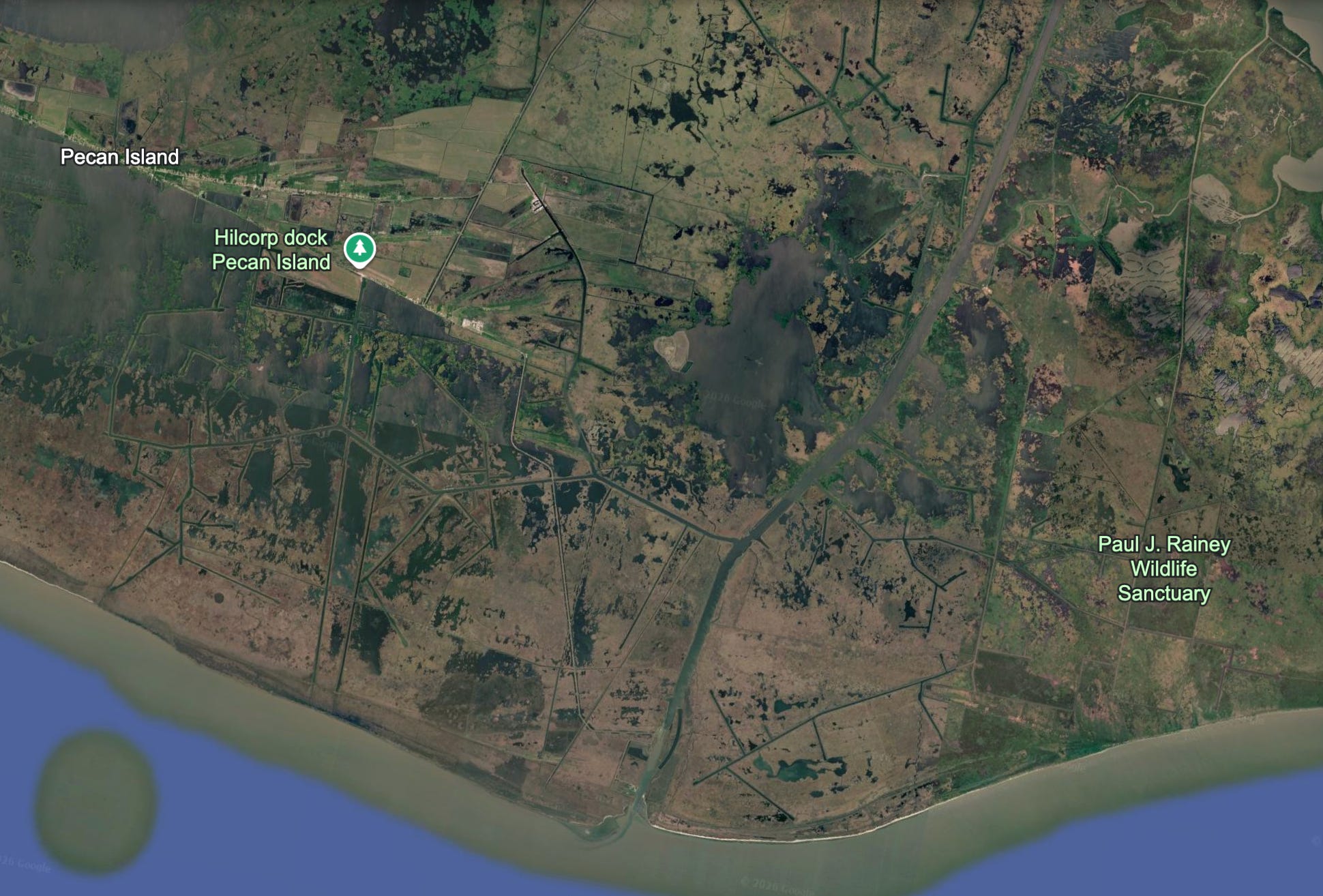
Among the species observed in the Rainey Sanctuary is the whooping crane, which conservationists have spent decades breeding in captivity to save from extinction. As part of a pilot reintroduction program, a small, non-migratory flock was established in Louisiana in 2011.
However, the reintroduction site, located in White Lake Wetlands Conservation Area, is less than 10 miles from SpaceX’s newly acquired property.
While whooping cranes have shown signs of recovery — the flock in Louisiana fledged a record 10 chicks this year — it is unclear how they will manage living close to a large industrial construction site and a steady stream of Starship launches beginning in 2029. (To accommodate numerous daily launches in Louisiana, SpaceX said it plans to build five rocket complexes and 10 launch pads.)
“There’s a reason that we put up [sound] barrier walls along most of our highways when they go through communities,” said Hartl of the Center for Biological Diversity. “Wildlife don’t get that same level of protection, and for many sensitive species, being exposed repeatedly to high-intensity sound can have significant physiological, behavioral impacts that can really impact their long-term survival, their ability to nest, to migrate.”
Many other species subsist off of the area’s wetlands: green herons, yellow rails, purple martins. They are among the 40% of all North American migratory birds that rely on Louisiana’s uniquely fertile but shrinking coastline at some point in their lives, according to Restore the Mississippi River Delta, an environmental coalition. Wetlands also provide habitats for fish, shrimp, and crabs, helping to employ more than 31,000 Louisianans in commercial and recreational fishing and seafood processing.
Additionally, many residents experience “less flood stress, less storm surge, less storm damage” because of wetlands, said Nyman. “The wetland absorbs some of that water and slows it down as it moves across the landscape.”
“Done as far from the public eye as possible”
Over the summer, Governor Landry signed numerous pieces of legislation into law specifically to benefit aerospace launch companies licensed by the Federal Aviation Administration (FAA). The legislative avalanche came weeks after an initial phone call in February between SpaceX and the Louisiana Economic Development agency.
One of the laws, HB 1098, seeks to exempt companies like SpaceX and their partners from legal liability for noise, air, and light pollution, as well as for vibrational damage.
“No aerospace flight entity that owns and occupies a minimum of twenty thousand contiguous acres in this state shall be liable for any cause of action arising from nuisance, trespass, inverse condemnation, strict liability, or any other claim based upon noise, sonic booms, overflight, vibration, light, heat, exhaust, smoke, odor, visual intrusion, temporary access restrictions, or any other disturbance resulting from aerospace flight activities,” the law states. (SpaceX is facing a class-action lawsuit from scores of Texas residents for alleged noise and vibrational damages.)
Another Louisiana law, HB 1250, practically offers a pledge of allegiance to the aerospace industry, declaring, “The continued development of aerospace flight activities in this state advances public welfare.” The same law states that aerospace companies, if sued, should be granted “early resolution without the imposition of discovery costs or other litigation expenses.”
Many of the lawmakers who helped arrange SpaceX’s fast-tracked entry into the state signed non-disclosure agreements to keep the dealings secret, according to the Louisiana Illuminator. Curiously, a third law, HB 1071, ensures that many of the government records related to aerospace projects will also remain hidden from public view.
Still more laws, HB 1179 and HB 1088, provide huge property tax exemptions for aerospace industrial sites and sales tax rebates for materials used to build and operate the facilities.
“I feel like [SpaceX is] trying to find places that are like the Wild West and have very little accountability,” said Hartl. “Given the overall approach that they’re taking, it just seems like this facility — whatever it’s going to be — it’ll be done as far from the public eye as possible.”
At the federal level, the Trump administration has recently made numerous efforts to neuter laws such as the Endangered Species Act, the Noise Control Act, and the Clean Air Act. Part of the effort involved a proposed FAA rule change last month to waive environmental review requirements for launch sites operated by private space companies.
What angers me isn't the environmental damage (although, that is important) it's how the politicians give billionairs whatever they want and act as if it's being done for the good for the state but it was really done because it was good for his wallet.
So, so,so tragic!!! What the hell???