

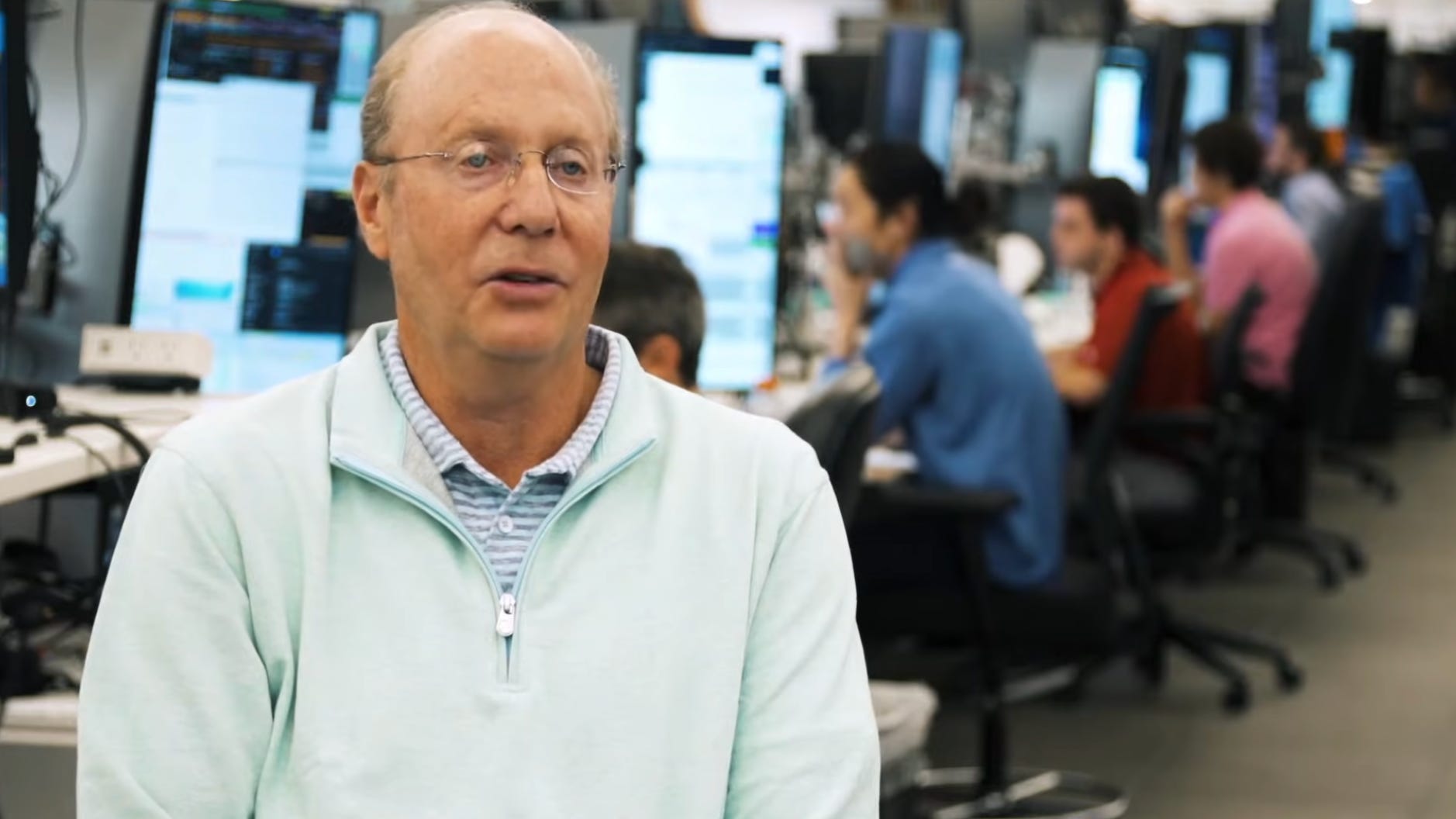
Jeff Yass, a right-wing megadonor and the 28th richest person in the world, is buying up large swaths of the town of Gladwyne, Pennsylvania. He says that the acquisitions are motivated by benevolence.
“This is an investment and a philanthropic effort,” Yass’s local partner, Andre Golsorkhi, recently told a crowd of Gladwyne residents while cryptically describing the development plans that the billionaire has in store for the small suburban community northwest of Philadelphia.
“I recognize that that is a challenging thing to sort of believe,” added Golsorkhi, who maintained that Yass — the wealthiest person in Pennsylvania and a power broker in state politics — views his spending in Gladwyne as a “community impact project.” Yass and his local partners have spent more than $15 million acquiring real estate in the town, including a local market, pharmacy, and a post office. His spending has alarmed residents and led to increased rents, which forced out local business owners, according to the Philadelphia Inquirer.
The extent of Yass’s plans for his Gladwyne properties remains unclear, but he has a history of shrouding his personal agenda in the language of philanthropy.
Over the last decade, the 70-year-old Yass has given more than $350 million to political campaigns, significantly increasing his spending in each cycle since 2020. He has also given heavily to the National Republican Senatorial Committee, a separate PAC for Republican Senatorial campaigns, and top House Republicans. Last year, he donated $16 million to Donald Trump’s super PAC, making him the president’s top individual donor.
Yass, a crusader for publicly funded school voucher programs, has framed the bulk of his political spending as altruism, telling the Washington Post last month that schoolchildren need an advocate to defy teachers’ unions. “They needed a philanthropist. I felt it was my role to be that philanthropist,” he said, referring to all the donations he has made to pro-voucher political candidates.
In the same interview, he claimed that voucher programs, which take money out of public schools by giving parents taxpayer funds to cover the costs of homeschooling or tuition at private and charter schools, could “relieve the suffering of tens of millions of kids.”
Much of Yass’s spending in the name of school choice also finds its way into the hands of political groups and candidates who support cutting taxes on the ultra-wealthy. He has given tens of millions to the Club for Growth, a conservative group that donates to GOP candidates and campaigns for lower taxes on the wealthy, voucher programs, and federal spending cuts.
Yass has, through various schemes, shielded much of his wealth from taxation. A 2022 investigation by ProPublica found that Yass avoided paying more than $1 billion in taxes over a six-year span, with his effective tax rate averaging about 19 percent annually, below the rate typically paid by Americans earning around $95,000 a year.
Yass has amassed much of his $63.5 billion fortune through his role as cofounder and managing director of Susquehanna International Group, a financial firm specializing in options trading.
Susquehanna has limited its tax liability in part by using a strategy known as “straddling,” which entails taking opposing positions on the same stock or market. This approach lets the firm classify profits as long-term capital gains, taxed at lower rates, while deducting losses that would otherwise be subject to higher taxation. Over time, the technique has enabled Susquehanna to claim billions of dollars in losses.
Yass and his firm were also among the earliest major backers of ByteDance, the Beijing-based parent company of TikTok, which is estimated to be worth as much as $500 billion. His 7% ownership stake in ByteDance is worth tens of billions.
That segment of Yass’s fortune appeared to be in jeopardy in 2024 when then-President Joe Biden signed a law requiring a nationwide ban on TikTok unless ByteDance sold its U.S. operations. But in March of that year, shortly before the House voted on the bill to ban TikTok, Yass personally met with Trump at a Club For Growth event near Mar-a-Lago. Although Trump had initially led the effort to proscribe the app by signing an executive order threatening its U.S. operations in 2020, he reversed course days after meeting with Yass, declaring publicly that he did not support a TikTok ban. “If you get rid of TikTok, Facebook and Zuckerschmuck will double their business. I don’t want Facebook, who cheated in the last Election, doing better,” Trump wrote. “They are a true Enemy of the People!”
Both men have claimed that TikTok was not mentioned during their meeting. Yass, for his part, has suggested the meeting was essentially philanthropic, telling Philadelphia magazine that he only discussed school choice with Trump. (Vanity Fair reported in 2024 that Yass’s political adviser, Tony Sayegh, spoke with a top Trump adviser at the time to convince him to change his position on TikTok.)
Yass’ $16 million donation to Trump’s Super PAC last year coincided with the president repeatedly using executive orders to halt the enforcement of the law banning TikTok.
As for Yass’s crusade for so-called “school choice,” he has spent tens of millions of dollars since 2018 promoting a voucher program in his home state of Pennsylvania. He spent similarly to elect lawmakers in Texas who helped establish a $1 billion statewide voucher system.
At the federal level, Trump has brought the education system closer to fulfilling Yass’s vision than any president. Under Trump, the Department of Education has sought to divert tax dollars from public schools to private, charter, and religious schools.
Additionally, embedded in the One Big Beautiful Bill, which Trump signed into law last year, is the Educational Choice for Children Act. Rather than functioning as a traditional voucher, it establishes a tax-credit system that allows individuals to claim up to $1,700 for contributions to nonprofit organizations that award scholarships. Those nonprofits may use the funds to help cover private school tuition and other education-related costs. While states are required to opt in to the program, individual governors can decide whether and how to implement it.
But for all of Yass’s claims about voucher programs uplifting impoverished children, such systems have had very different outcomes in practice. Arizona’s universal school voucher system diverted such a large share of state funds that it led to hundreds of millions in cuts to core public services, including funding for community colleges and maintenance of roads and school facilities. And in many Republican-led states, vouchers are merely used by families whose children were already enrolled in private schools.
More Luigi. Less Yass
it's so hard to boycott these oligarchs because they are all in the market.... but let them pour money into elections and their politician looses ... one can only hope