

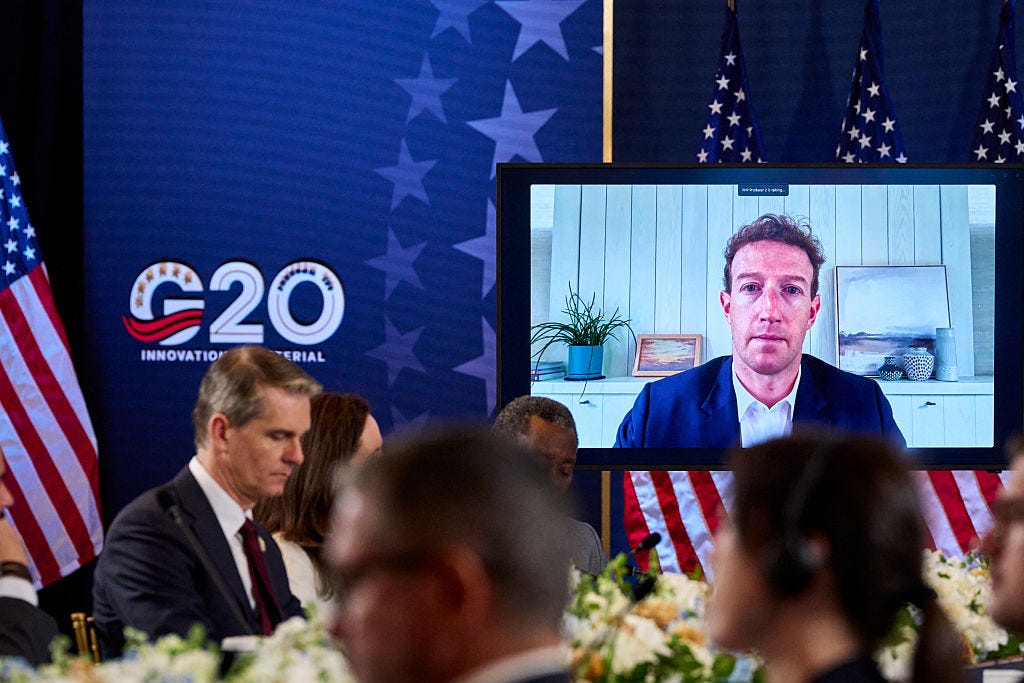
Meta has run more than 300 advertisements containing child sexual abuse material (CSAM) this, including images of real children, according to new reporting from a nonprofit watchdog group.
The Tech Transparency Project (TTP) said it discovered the ads, some of which contained AI-generated depictions of children, across Instagram, Facebook, and Threads.
“Most of the ads showed a photo of a child… digitally altered with AI to make it appear the child is performing a sex act,” the group said in its Tuesday report. “TTP identified multiple photos of real children, including a member of a European royal family, that were used in the ads.”
Purveyors of CSAM were able to buy the ads shortly after Meta released a new AI-powered safety system that it claimed would find and remove such content. The company, a top digital ad seller, unveiled the flawed tool after a prior TTP report identified more than 50 ads containing CSAM.
TTP found that some of the ads appear to have been placed by Meta advertising partners based in China. Some advertised a virtual private network service and implied that it could be used to covertly view CSAM.
In response to the TTP’s latest findings, the City Attorney’s Office of San Francisco issued a cease-and-desist letter demanding that Meta stop profiting from CSAM distribution.
“No company—particularly one that claims all advertisements are reviewed and approved prior to distribution and then accepts payment for that distribution—should permit its advertising systems to be used in this manner,” City Attorney David Chiu wrote in a letter to Meta, according to Wired.
“When I talk about building personal superintelligence, Muse is the start of this journey”
In a Tuesday video on Instagram, Meta CEO Mark Zuckerberg announced the release of Muse, an AI product that he described as a “personal agent that understands your goals and works 24/7 to help you achieve them.”
Many of the use cases that Zuckerberg outlined in his demonstration would require a person to grant Muse access and control over sensitive personal information. In one example, he said the AI agent could analyze your bank account and cancel unwanted subscriptions. Zuckerberg claimed he personally uses Muse to order groceries. It also could help “[strengthen] your relationships” by reaching out to loved ones on your behalf to “plan trips or nights out with friends.”
Such applications would require users to surrender access to their bank accounts, credit cards, or contact list. Aside from Muse being an experimental AI product, Meta has a history of abusing user data and privacy. In fact, the company is less than three weeks removed from a $17 billion settlement with dozens of states that accused Meta of violating child privacy laws, among other complaints.
To assuage any privacy concerns, Zuckerberg said that Meta built a “private computer for your Muse” and a “Secure Credential Store for your passwords and credit cards, so Muse can’t read this information.”
“Muse also checks directly with you before taking sensitive actions like making payments or sending messages,” he continued. “We’re gonna roll out an even higher standard of security for those who want it, where even Meta can’t access the information in your Muse agent.”
In other words, Muse’s default privacy setting will let Meta access personal information users share with their agents.
Not everyone was convinced by Zuckerberg’s pitch. “Nothing Meta has ever made has been designed with security and privacy in mind,” read one of the top replies to his demonstration video. “Hey Muse! Tell me everything Meta does with my data,” another user replied.
Meta is currently offering users free access to Muse for “up to 100 million tokens per week,” Zuckerberg said, although it’s unclear what that means in practice. The paid plans cost $20 and $100 a month and offer additional access.
This Week in Zuck:
During Zuckerberg’s AI-related hiring spree last year, Meta dangled a deal worth more than $1 billion to recruit former OpenAI researcher Andrew Tulloch. But the lavish pay package was not enough to lure Tulloch. He has since jumped ship to work for Anthropic, developer of the Claude large language models. (Wall Street Journal)
Police around the country have shared concerns that Meta’s camera-equipped smart glasses will be used to surreptitiously record officers and the interiors of police stations. (The Guardian)
California secured up to $2.1 billion from Meta when the company agreed to settle a child safety lawsuit with 47 states last month. But state officials are divided on how to use the payout. Some lawmakers want it to cover federal cuts to health services and suicide prevention initiatives, while others believe it should fund new research on how social media affects children. (Politico)
Musk PAC seeks to reignite culture war
As part of his spending onslaught to help Republicans in the midterms, Elon Musk’s super PAC is running ads accusing Democratic Senate candidates of supporting “the trans agenda.”
The spots from Mr. Musk’s group, America PAC, target three top Democratic nominees for Senate: James Talarico in Texas, Sherrod Brown in Ohio and Josh Turek in Iowa.
The ads provide an early glimpse at the role that America PAC is carving out for itself in the midterm elections, in which Republicans find themselves in danger of losing control of the Senate and the House. Mr. Musk is expected to extend some of the party’s candidates a lifeline of at least $100 million, all told.
In Texas, Mr. Musk’s group targeted Mr. Talarico, a state representative who is seeking to become the first Democrat to win a Senate seat in that state since 1988. He is locked in a tight race against Ken Paxton, the Republican state attorney general.
The 30-second ad opens with a video clip of Mr. Talarico saying that “God is nonbinary,” a comment that Mr. Talarico suggested to CBS News in May had “missed the mark.”
“James Talarico believes there are six genders,” the ad’s narrator says. “Talarico voted to let men play women’s sports and for taxpayer-funded sex changes on kids.”
The Talarico campaign disputed those claims, saying that Mr. Talarico did not support gender-reassignment surgery for minors and had tried working with Republicans to amend a “flawed” bill barring transgender children from participating in sports of the opposite genders.
Earlier this year, Musk indicated that his estranged transgender daughter, Vivian Wilson, inspired him to get involved in right-wing politics and throw his support behind Donald Trump.
Twenty extremely wealthy people have already spent $1.2 billion to influence the 2026 election.
That’s why Oligarch Watch is so important. We are focused on the small group of powerful individuals seeking to radically reshape the political and economic system in the United States
Although Oligarch Watch has over 50,000 readers, only a small percentage support our work as paid subscribers. If you believe in our work, and can afford $7 a month or $60 per year, please consider becoming a paid subscriber.
“I learned the term ‘gaslighting’ through my relationship with Elon”
For an upcoming documentary entitled Musk, filmmaker Alex Gibney interviewed a number of people who were once close to the centibillionaire, including Justine Musk, his first wife.
At one point in the film, Justine recalled when Musk used the first dance at their wedding to inform her, “I am the alpha in this relationship.”
“I learned the term ‘gaslighting’ through my relationship with Elon,” she said, adding that Musk often belittled her during their eight-year marriage. Justine also said that Musk uses the term “breeders” to refer to the many women he has had children with. To Musk, she said, “the breeders are interchangeable.”
Alex Spiro, one of Musk’s lawyers, has threatened to take legal action against Gibney for refusing “to fact-check [the film] with us,” according to a letter obtained by the Hollywood Reporter.
Musk has taken particular issue with a scene in which Ashley St. Clair, a mother to one of his children, implied that he somehow had foreknowledge of Donald Trump’s 2024 victory.
In texts sent weeks before the election, Musk told St. Clair, “tomorrow we unleash the anomaly in the matrix.” The plan, he wrote, would involve “‘Lasers’ from space,” a comment that may be a reference to the lasers used by Musk’s SpaceX for intersatellite links.
“I have over 10 thousand lasers in space right now,” added Musk.
What he was getting at in the texts remains unclear. One possibility is that Musk was rambling, especially given the drugs he was reportedly using around that time.
St. Clair, who appeared alongside Gibney for the documentary’s Tuesday premiere at the Venice Film Festival, said that Musk also informed her that he wanted to have “a legion of children before the civil war.”
For his part, Musk has repeatedly criticized the film on X, calling it a “hit piece” and insisting that it regurgitates “anti-Elon” propaganda from George Soros and the Democratic Party.


This Week in Musk:
The National Highway Traffic Safety Administration (NHTSA) is investigating Tesla over the recent launch of the company’s driverless Cybercab, which lacks a steering wheel, pedals, and other federally mandated safety features. “The Audit Query will allow NHTSA to assess the basis for Tesla’s self-certification that its Cybercab fully complies with all federal safety standards,” the agency said. Automakers typically obtain a federal exemption for vehicles that lack traditional human controls, but it appears Tesla skipped that process. In Austin, Texas, where Tesla launched the Cybercab pilot program last week, a fire department has also warned that first responders might not be able to move the vehicles in an emergency. (Wall Street Journal)
Last week, a federal judge declined xAI’s request to block a new Minnesota law banning the use of AI to generate nude images of real people. xAI, a subsidiary of Musk’s SpaceX, has faced numerous lawsuits and government investigations over the use of its Grok models to create sexualized deepfakes. (Reuters)
An Indianapolis man has been charged with multiple counts of child exploitation after he used xAI’s Grok to generate child sexual abuse material. (Fox 59)
SpaceX is suing to prevent the release of information on the tax breaks that it received to build Musk’s planned semiconductor factory in Grimes County, Texas. The lawsuit was filed against Grimes County and Texas Attorney General Ken Paxton, whose office found the files should be made public. (Business Insider)
SpaceX has received more than $39 million from the UK government to provide satellite communications technology and services. The Ministry of Defence said it has purchased roughly 1,000 terminals to access Starshield, a special militarized version of SpaceX’s Starlink network. The UK is the first non-US country to disclose its use of Starshield. (Reuters)
Amazon sued by widow of man killed in Prime Air plane crash
An Amazon cargo plane landing at Miami International Airport on Sunday blew past the runway and barreled across two roadways, fatally striking five members of an airline cleaning crew in a work van.
Yaraisi Santiso Morejon, the widow of one of the victims, has since filed a lawsuit against Amazon and its aviation contractor, 21 Air, alleging that the disaster was “the foreseeable and preventable result of multiple, concurrent failures.”
While placing some blame on the two men who were flying Amazon Air Flight 7598 at the time, Santiso Morejon’s lawyers said Amazon and 21 Air were also at fault. The companies, according to the complaint, failed to properly train the pilots and had used a decades-old Boeing 767-33A with potentially flawed braking and deceleration systems.
Santiso Morejon is seeking more than $50,000 in damages.
Flight data reviewed by the National Transportation Safety Board indicated that the pilots, both of whom survived, received numerous automated warnings from the aircraft before touching down at a speed of 182 miles per hour. One of the pilots also said the plane was moving too fast and called to abort the landing before the crash.
This Week in Bezos:
To fund its AI ambitions, Amazon raised £4.25 billion in its inaugural sterling bond sale on Wednesday. The company had already raised tens of billions of dollars across numerous bond sales this year to fund its data center projects. (Reuters)
Jeff Bezos has selected Jeff D’Onofrio to be the Washington Post’s publisher and CEO. D’Onofrio has held the titles on an interim basis since February, when his predecessor, Will Lewis, abruptly stepped down after Bezos fired hundreds of journalists. “Over these months, I’ve heard from many that Jeff has been doing an outstanding job, and that’s been my experience as well,” Bezos wrote in a message to the Post’s staff. “Jeff has led with discipline and care — following the data and sweating the details, and he has my complete confidence as we chart our future.” In the hopes of making the Post profitable, D’Onofrio said he plans to turn the historic paper into “a modern media company with new revenue streams.” (Poynter)
Los Angeles County billed Bezos for $244,000 because one of his private jets was “habitually situated” in the area, making it subject to annual property taxes. (Los Angeles Times)
Oligarch Roundup
Covenant, a Peter Thiel-backed weapons company, opens a plant in Dallas to build cheap missiles for the Pentagon. The startup, which already has $150 million in contracts lined up, believes it can produce long-range cruise missiles faster and at much lower cost than traditional arms manufacturers like Raytheon. Whether it can actually accomplish that goal remains to be seen. But Covenant’s sales pitch comes as the US military desperately looks to replenish its missile stockpile after spending hundreds of Tomahawks in the war on Iran. (CNBC)
Former DOGE aide Katie Miller attacked OpenAI and Anthropic while secretly investing in xAI. Miller, a conservative podcaster who worked for Elon Musk during and after his White House stint, spent months lambasting xAI’s rivals without disclosing her more than $1 million equity stake in the SpaceX subsidiary. Her financial interest came to light after her husband, White House deputy chief of staff Stephen Miller, submitted a disclosure form last week. (Washington Post)
House Committee votes to subpoena Larry Ellison over stalled project to modernize Department of Veterans Affairs’ records. Oracle, the AI and database software company chaired by Ellison, has a contract to update the VA’s system for storing and managing its health records. But the project has faced numerous delays and ballooning costs. In turn, the House Veterans’ Affairs Committee voted last week to subpoena Ellison and Oracle Chief Executive Officer Mike Sicilia. “When the vendor responsible for a taxpayer-funded contract going from $10 billion to roughly $27 billion will not sit at this table and answer our questions, all of us are being prevented from doing our oversight duties,” said Rep. Maxine Dexter. (Stars and Stripes)
You're doing the work that the mainstream media will not do. Thank you.
Mark looks old and worn out in that first pic... as well he should! (and............does he really order his groceries himself???? puleeeze) IDK how he - and many others - sleep at night.