

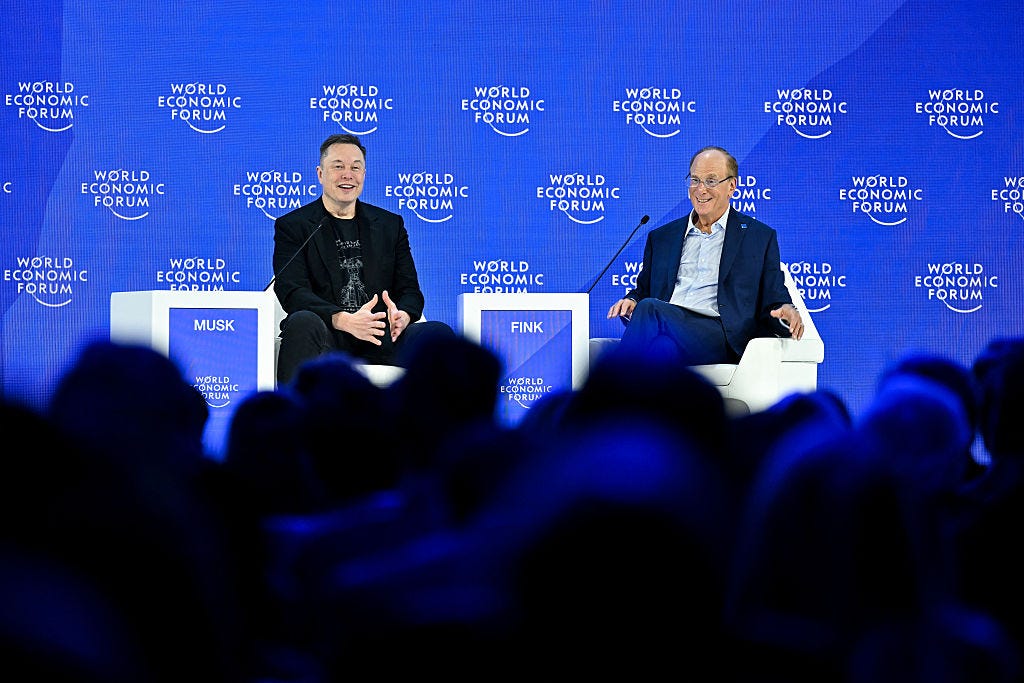
After years of describing the World Economic Forum as both “boring” and an “unelected world government” plotting to “be the boss of Earth,” Elon Musk on Thursday made a surprise first appearance at the forum’s annual meeting in Davos, Switzerland. While there, the world’s richest man joined fellow billionaire Larry Fink, the CEO of BlackRock, on stage for a question-and-answer session.
Musk spent the chat rolling out variations of promises that he has failed to live up to in the past. Tesla’s robotaxis will be “very widespread by the end of this year in the U.S.,” he said, a prediction he previously set for the end of last year before it failed to materialize. He also said Tesla would begin selling its humanoid Optimus robots by next year, despite having already suggested in 2024 that they would be available by the end of last year.
Despite Musk’s recently rekindled friendship with Donald Trump, the centibillionaire did knock the White House’s tariff policies for artificially increasing energy costs at a time when AI companies are scrambling for more power than ever. On the topic of solar energy, he said, “You could take a small corner of Utah, Nevada, or New Mexico — a very small percentage of the area of the U.S. — to generate all of the electricity that the U.S. uses.”
“Unfortunately, the tariff barriers for solar are extremely high, and that makes the economics of deploying solar artificially high,” he added.
Musk also ribbed Trump’s newly formed Board of Peace, an apparent U.N. rival body with a $1 billion membership fee that would report exclusively to the president. “I heard about the formation of the peace summit, and I was like, is that p-i-e-c-e? You know, a little piece of Greenland, a little piece of Venezuela,” said Musk, who cackled at his own joke.
How the Trump administration has supported Musk amid xAI’s scandals
A new report reveals how the Trump administration has worked to silence and subdue critics of xAI, Musk’s combined artificial intelligence startup and social media company. From Politico:
The Trump administration recently stumbled into a surprising international fight over what the State Department describes as “free speech” on social media. The “speech” in question? Sexualized images of women and children that have been generated by Elon Musk’s Grok AI chatbot. After U.K. officials threatened to ban X for not stopping the proliferation of these deepfakes, Sarah B. Rogers, a senior Trump appointee at the State Department, responded that “nothing is off the table” as the Trump administration considers ways to ensure people retain the previously unknown right to digitally undress whoever they want whenever they want, including kids…
The most dramatic intervention of the Trump administration, however, occurred in late December, when Secretary of State Marco Rubio announced that the State Department had barred five people from entering the country because they have publicly advocated for social media regulation and content moderation.
Rubio described the group in a statement as “radical activists” who were part of a “global censorship-industrial complex.” They included a former senior European Commission official who helped craft the European Union’s Digital Services Act, a law that targets social media manipulation and illicit content and that recently resulted in a $140 million fine for X.
Despite Rubio and the administration’s claims, the fine had nothing to do with regulating the content of anyone’s speech. It was imposed because Musk’s company allegedly violated the EU’s law by employing a deceptive design for its blue checkmark, by maintaining an insufficient ad repository and by failing to provide third-party researchers with access to the platform’s public data.
The report goes on to note that Rubio sought to deport Imran Ahmed, a legal permanent resident of the United States whose wife and child are U.S. citizens. Ahmed is the chief executive of the Center for Countering Digital Hate (CCDH), a group that has investigated Musk and X for allowing white supremacist content to flourish on the platform. Musk sued the group in 2024 for supposedly causing X to lose “tens of millions of dollars” in ad revenue, but a federal judge threw out the lawsuit. Now, the Trump administration is looking to remove him from the country on the specious grounds that he was a “key collaborator with the Biden Administration’s effort to weaponize the government against U.S. citizens.”
This Week in Musk:
The Justice Department disclosed in recent court filings that two members of Musk’s DOGE team at the Social Security Administration had surreptitious contact with a political advocacy group aiming to “overturn election results” in a number of states. One of the DOGE staffers signed an agreement to share Social Security data with the group. (Popular Information)
The EPA this week moved to block a loophole that Musk’s xAI startup relied on to quickly power its first data center in Memphis. The EPA ruled that xAI violated the law when it sidestepped the air-pollution permit process by running gas turbines mounted on trailers and classifying them as temporary “non-road engines.” Under the revised EPA rule, those turbines no longer qualify for exemptions, and companies must secure Clean Air Act permits before installation. xAI is now seeking permits for 41 natural gas-fired turbines to power its new, 800,000-square-foot facility in Southaven, Mississippi, which is less than 15 miles from its sprawling Memphis data center. (The Guardian)
Musk is reportedly “racing” to take SpaceX public to fund his plan to build a network of space-based AI data centers. (Wall Street Journal)
Musk donated $10 million to a PAC backing Nate Morris, a Kentucky Republican looking to fill outgoing Sen. Mitch McConnell’s seat. (Louisville Courier-Journal)
During a social media squabble with Ryanair CEO Michael O’Leary, Musk asked his followers on X whether he should buy up the Irish airline. The fight began when O’Leary said in a radio interview that Musk was clueless about planes and insisted that he would not install SpaceX’s Starlink internet on Ryanair’s fleet. “I frankly wouldn’t pay any attention to anything Elon Musk puts on that cesspit of his called X,” added O’Leary, who has since described the feud as being great for business. (The Irish Times)
FTC appeals antitrust case against Meta
On Tuesday, the Federal Trade Commission filed an appeal of the lawsuit it lost last year, accusing Meta of violating antitrust laws by creating a social media monopoly. Meta, the parent company of Facebook, Instagram, WhatsApp, and Threads, won the lawsuit at trial in November after a U.S. district judge rejected the FTC’s case to break up the company. But the government agency, which argued that Meta used monopolistic practices to buy up and smother emergent competitors, has not given up on the case.
“Meta violated our antitrust laws when it acquired Instagram and WhatsApp,” FTC spokesman Joe Simonson told the New York Times. “Thankfully for Americans, there is an appeal process.” In its fight against Meta, the FTC will look to repeat its successes against Google, which it sued for creating monopolies in the online search and advertising technology industries.
This Week in Zuck:
With the state of New Mexico suing Meta for failing to prevent the sexual exploitation of minors on its platforms, the company has asked the court to prohibit some personal references to employees and Zuckerberg during the trial. As reported by Wired, Meta’s request included a ban on “any references to Meta’s financial resources, the personal activities of employees, and Mark Zuckerberg’s time as a student at Harvard University.” (Wired)
During Trump’s speech at the World Economic Forum, the president mentioned Meta’s Mark Zuckerberg by name while commending his AI ambitions. “Mark Zuckerberg showed me a plant where he put it over a map of Manhattan, and it was basically the size of Manhattan,” said Trump. “I said, ‘You’ve got to be kidding.’ It was miles long, miles wide, and very high. It literally covered most of the island.” He added, “If you spend $500 million, you can build a good shopping center. But how do you spend $50 billion? When I looked at this thing, I understood why.” The comments spurred a notable boost to Meta’s share price. (Fortune)
Reels, the Instagram feature seen as a listless TikTok clone when it launched in 2020, has become a massive money-maker for Zuckerberg. The scrollable, short-form video product accounted for the majority of ads on Instagram in 2025, according to new data from Sensor Tower. In October, Meta projected that Reels would generate $50 billion in annual revenue. (CNBC)
Remember that groundbreaking change to remote work that a floating avatar of Zuckerberg promised on CBS a few years ago? At the time, CBS host Gayle King and Zuckerberg conducted what was billed as the “first-ever virtual reality interview in Facebook’s new ‘Horizon Workrooms.’” Those workrooms were a major driver in Zuckerberg’s decision to turn Facebook into Meta, but they’ll soon be gone for good. “Meta has made the decision to discontinue Workrooms as a standalone app, effective February 16, 2026,” the company disclosed this week. (The Verge)
Palantir boss claims AI will end most immigration
While at the World Economic Forum, Alex Karp, the billionaire CEO of Palantir, suggested that advances in AI will stop people in the Global South from immigrating to wealthier countries. “There will be more than enough jobs for the citizens of your nation, especially those with vocational training,” he said during a speaking event with BlackRock CEO Larry Fink, a fellow billionaire. “I do think these trends really do make it hard to imagine why we should have large-scale immigration unless you have a very specialized skill.” During the same talk, Karp, whose AI company profits heavily from enabling mass government surveillance, claimed that AI technology somehow “bolsters civil liberties.”
Musk seeks up to $134 billion in damages from OpenAI and Microsoft
As part of his federal lawsuit against OpenAI and Microsoft, Musk is seeking up to $134 billion from the firms, alleging they unfairly profited from his initial investments, advice, and contributions to employee recruitment, according to Reuters. Musk helped cofound OpenAI in 2015, left the board three years later, and then sued the ChatGPT maker in 2024 for allegedly abandoning its founding non-profit mission. Microsoft was added as a defendant in the lawsuit due to its role as OpenAI’s top investor.
OpenAI, for its part, warned investors last week to prepare for “deliberately outlandish, attention-grabbing claims” made by Musk. “We have strong defenses and feel confident about our chances of winning the case,” OpenAI wrote in the investor letter. “Regardless, based on the record so far, we believe this case is worth no more than the $38M that Elon donated — though that is not a guarantee.”
Oligarch Roundup
Inequality survey finds billionaire wealth has reached record highs. Oxfam, an international confederation of NGOs fighting global poverty, found in its annual inequality survey that the collective wealth of the world’s billionaires has reached a record $18.3 trillion. (The Guardian)
Tech barons who attended Trump’s inauguration just keep getting richer. A Financial Times report found that the Silicon Valley barons who attended Trump’s inauguration last January saw banner returns over the first 12 months of the new administration, with the assets of Musk, Bezos, Zuckerberg, Altman, and Apple’s Tim Cook all ballooning. (Financial Times)
Amazon CEO says Trump-era tariffs are beginning to show up in consumer prices. “So you start to see some of the tariffs creep into some of the prices, some of the items, and you see some sellers are deciding that they’re passing on those higher costs to consumers in the form of higher prices, some are deciding that they’ll absorb it to drive demand and some are doing something in between,” Amazon CEO Andy Jassy said during an interview at the World Economic Forum. “I think you’re starting to see more of that impact.” (CNBC)
Gates Foundation and OpenAI to test AI healthcare project in Africa. The Gates Foundation, a charitable fund with an $86 billion endowment, announced on Wednesday that it will partner with OpenAI on a $50 million health project in Africa “to accelerate the adoption of AI tools across primary care clinics, within communities, and in people’s homes.” Speaking at the World Economic Forum on Wednesday, Bill Gates, the 17th-richest person in the world, described Africa as a proving ground for AI applications in health care. “In order to, you know, make this a reality, to see what works, what doesn’t work… we’re thrilled that OpenAI and the Gates Foundation are committing an initiative called Horizon1000, where we’re going to a thousand primary health care clinics in Africa,” the Microsoft co-founder said. Rwanda will be the first country to take part in the Horizon1000 project. (The Hill)
ChatGPT to debut ads, contradicting Altman’s past comments. OpenAI will soon inject ads into ChatGPT for free and low-tier paid users in the U.S. In 2024, Altman excoriated mixing advertising with the chatbot experience. “Ads plus AI is sort of uniquely unsettling to me. I kind of think of ads as a last resort for us for a business model,” he said at the time. Altman backtracked this week on X, writing, “It is clear to us that a lot of people want to use a lot of AI and don’t want to pay.” On a related note, OpenAI is desperate for money, with a new report projecting that it could lose $14 billion this year. Altman also recently met with Middle East investors seeking funding for a new $50 billion investment round. (CNBC)
The world's largest pedophile convention.
Many of us would love to have the option to turn off AI where when fact checked, answers are often erroneous. Then there's Musk. For some reason (let's call it self-promotion) people mistake the world's richest man for the world's smartest man. Then he opens his mouth.