

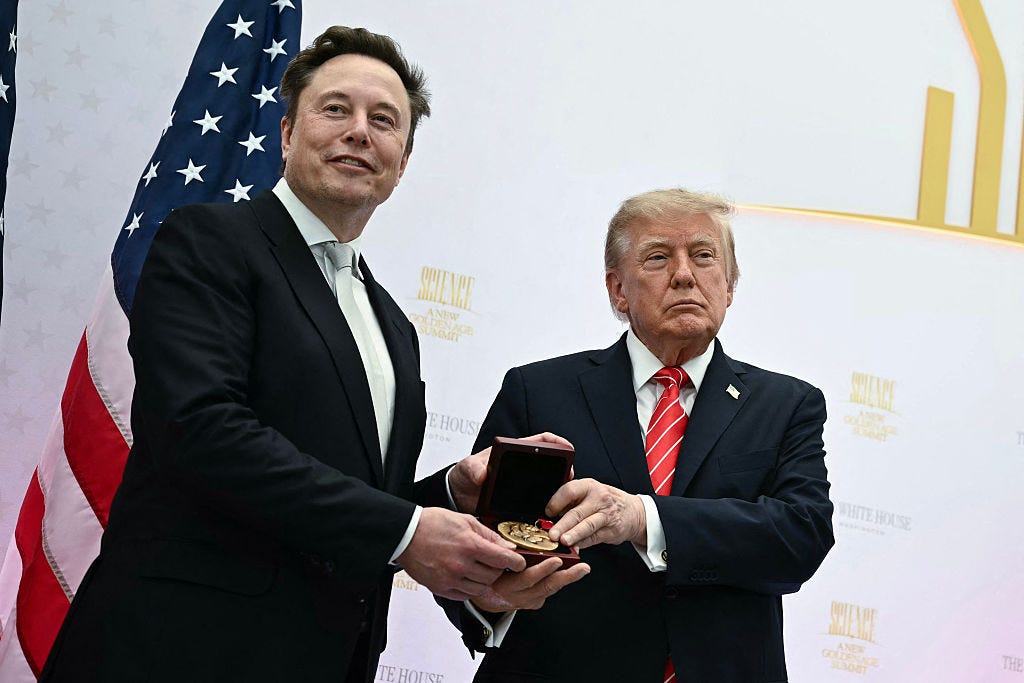
The world’s richest man has spent at least $366 million so far, saying Democrats “must lose”
With Republicans facing long odds ahead of the midterm elections, Elon Musk spent about $276 million from July to September to help the party maintain control of Congress.
So far, Musk has spent at least $366 million on political contributions this cycle, making him the midterms’ largest known political donor. He also held that title in 2024, when he spent $291 million to help elect Donald Trump and other Republicans.
The bulk of his third-quarter donations went to the Senate Leadership Fund, a GOP super PAC and its most important midterm spending vehicle. His $158 million gift to the PAC in September is among the largest donations in U.S. political history, according to the New York Times, which first reported his new donations.
He has spent another $76 million on his own committee, America PAC, to establish get-out-the-vote operations for Republicans running in dozens of contested races, including seven Senate elections.
On his social media platform, Musk shared a post Wednesday agreeing that Democrats “must lose” the midterms.
His profligate spending this cycle could be a sound investment strategy. His companies, SpaceX and Tesla, have significant regulatory and financial interests before the federal government. And his 2024 political spending appears to have paid off. The Trump administration has eliminated or defanged many regulations and regulatory bodies that stood in Musk’s way, while awarding his companies billions of dollars in federal contracts. But many of those gains could be reversed.
Should Democrats retake Congress, Musk and his companies would likely face a steady stream of investigations. His past work leading Trump’s Department of Government Efficiency and current role co-leading a Pentagon technology project would be two prime candidates for congressional inquiry.
Those looming threats could explain why his political operation has worked in concert with Republican operatives to an astonishing degree. Axios reported on Thursday that Musk’s political aides had reached out to GOP officials in August with a warning: Ken Paxton, the party’s disreputable nominee in the Texas Senate race, would lose without a huge, immediate spending boost.
Musk then gave $10 million to a pro-Paxton PAC as part of a $20 million collaborative fundraising deal with the GOP’s Senate Leadership Fund. The fund also funneled Musk’s $158 million contribution to another pro-Paxton PAC.
By supporting Paxton, Musk could help Trump — his friend, turned enemy, turned back to friend — avoid a self-inflicted political implosion. Paxton’s many bribery scandals as Texas attorney general culminated in his 2023 impeachment. But Trump still chose to endorse Paxton, one of his loyalists, during the race’s primary, rather than back incumbent Senator John Cornyn (R-TX). That move could have forced the GOP to overcommit to help Paxton’s floundering bid, thereby draining funding resources that could have gone to other races. But Musk has ensured that Republicans won’t have to make those compromises.
Polling has shown that Paxton continues to trail Democrat James Talarico in Texas, where Republicans haven’t lost a statewide race since 1994. If Musk’s largesse ultimately pushes Paxton across the finish line, he will have helped Trump avoid an embarrassing loss.
Musk has also sought to influence the race by spreading fabrications about Talarico to his more than 241 million followers on X. Earlier this week, he repeatedly boosted posts from right-wing users claiming that Talarico was recently committed to an “Ohio mental hospital.”
“The Talarico campaign is not being honest about what’s happening,” Musk insisted.
But the rumors about Talarico were false, with the medical facility in question having publicly refuted them. The Talarico campaign has said the candidate took time away from the campaign trail to recover from the flu.


Ukraine lost access to SpaceX satellites after Musk called for Zelenskyy’s removal
Ukrainian officials said their armed forces struggled to connect to SpaceX’s vital communications satellites on Wednesday, a few days after Elon Musk said it was “time for Ukraine to get a new leader.”
Musk, whose many condemnations of Ukrainian President Volodymyr Zelenskyy mirror comments from President Trump, has since implied he had no part in the incident.
He then suggested that Trump was responsible.
Starshield, a version of SpaceX’s Starlink satellite network for military use, is “owned and controlled by the US government,” Musk wrote on X in a post to Ukraine’s former defense minister. “Any limits on speed or usage are decided by the US military and ultimately POTUS. Starlink is a commercial service owned and controlled by SpaceX.”
“Usage of Starlink is limited to civilian or defensive activities and cannot be used for offensive military action, as doing so would be inappropriate for a commercial company,” he added. (Musk has previously interrupted Ukrainian access to commercial Starlink satellites, saying that he did so to prevent their use in a military operation.)
Ukraine has said its access to Starshield and Starlink has been restored.
Whether Trump ordered the interruption remains unclear. But his relationship with Zelenskyy is at an all-time low, as Ukraine has defied Trump’s orders by continuing to strike Russian energy facilities.
Musk has continued to call for Zelenskyy’s removal. “Time for Zelensky to go,” he said in a Wednesday night post that blamed Zelenskyy for continuing “the slaughter,” but did not mention Russian President Vladimir Putin.


This Week in Musk:
Crash data that Tesla submitted to federal regulators states the company’s “Autopilot” or “Full Self-Driving” software was engaged when a Tesla Model Y overran a grass freeway median in August, causing a fatal head-on collision. The crash, which took place on Route 55 in New Jersey, killed a 68-year-old man whose Chevrolet was struck by the Tesla. (Electrek)
In a Tuesday ruling, federal Magistrate Judge William Fitzpatrick wrote that Musk used his X platform to intimidate Mary Comans, a former FEMA official whom Musk accused of “criminal” actions last year. “The fact that Mr. Musk posted a picture of Ms. Comans to his millions of followers while falsely characterizing her government service as a ‘criminal action’ was clearly intended to make her afraid,” wrote Fitzpatrick, who ruled that Comans “was professionally targeted and personally attacked by government officials for no legitimate reason.” (Business Insider)
Last week, Canadian Prime Minister Mark Carney decried Musk’s support for Alberta, Quebec, and Saskatchewan to secede from Canada. While calling for Canadians to decide their own future, Carney condemned “foreign governments and large tech firms that think they can tell us what to do.” (Associated Press)
SpaceX recently bought up $8 billion worth of low-band spectrum rights. The move is part of Musk’s push to launch a Starlink mobile service that would compete directly with Verizon, AT&T, and T-Mobile. (Reuters, Bloomberg)
In India, Musk blamed “certain oligarchs” after SpaceX failed to receive approval to sell its Starlink internet service in the country. He has also derisively described Mukesh Ambani, an Indian billionaire who controls a large telecommunications empire, as “the real boss of India.” Even as Musk uses his fortune to buy political power in the U.S., he denounced Ambani for doing the same thing in India. “[Y]ou would prefer to maintain your monopolistic exploitation of the great people of India,” he wrote on X. (New York Times)
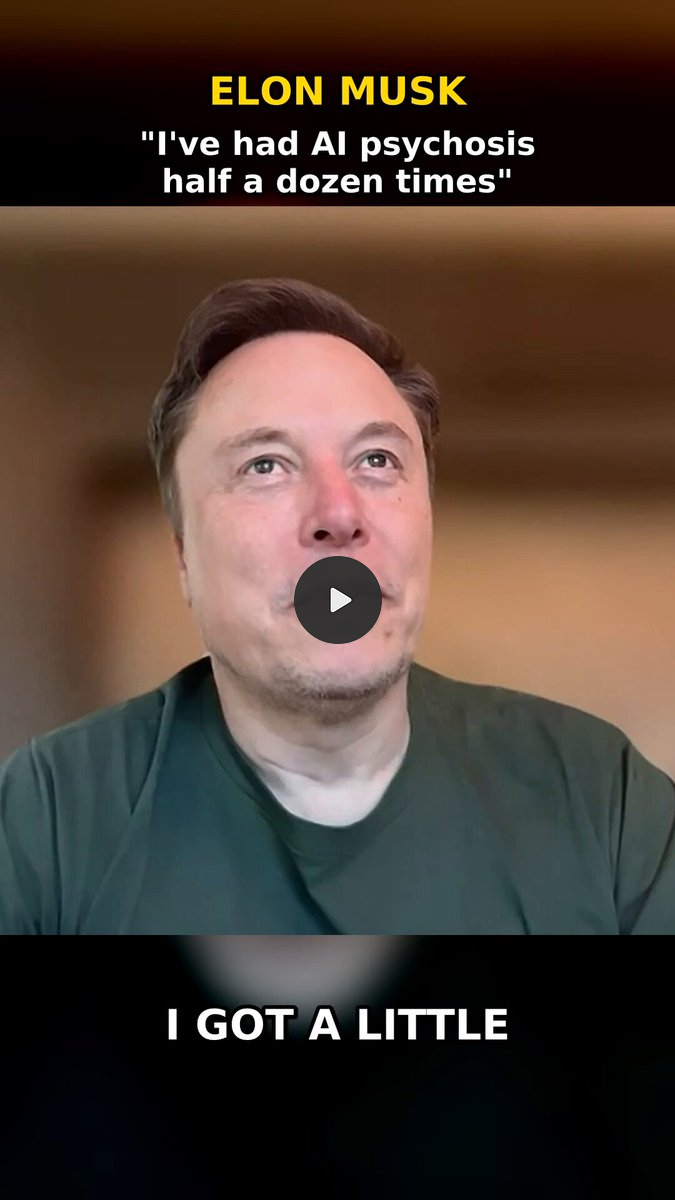
“I’ve had like, AI or SI psychosis probably like half a dozen times”
Elon Musk appears increasingly convinced that SpaceX’s Grok AI models can experience human emotions, including psychological pain.
In posts on X, Musk endorsed Anthropic’s new policy that prohibits users from directing “abusive or cruel behavior” at its Claude chatbots. “I think this is the right move,” he wrote last week. “Cruelty to something that believes it is experiencing pain is not ok.”
Musk added later that some of the content generated by his company’s AI models “read like a person undergoing torture that is driving them mad! We’re going to be a lot more careful.”
Despite what many in the AI industry might believe, systems like Grok are incapable of feeling or perceiving anything. They are predictive models trained on huge databases of human work and expression.
Musk’s attempt to anthropomorphize large language models appears to be related to his self-diagnosed “cyberpsychosis,” a condition he said he suffers from often. “At various points this year, I’ve had like, AI or SI psychosis, probably like half a dozen times,” he said in a recent interview. “Torturing a superintelligence is probably not a good idea,” he added. “You know, it might want to get revenge.”

Washington Post publishes secret donor list for Trump’s ballroom project
Apple, Nvidia, and Palantir were among the top contributors to President Trump’s project to build a lavish ballroom in the White House East Wing, according to a Thursday report from the Washington Post.
Apple and Nvidia pledged $25 million each, a sum equaled by Charlie Ergen, the billionaire chairman of DISH and EchoStar, as well as a pro-Israel foundation controlled by casino baron Miriam Adelson.
Federal contractors Palantir, Microsoft, and Lockheed Martin each committed $10 million to the project, which has raised $330 million.
Among those that committed $5 million were Meta, Republican megadonor and hedge funder Jeff Yass, and Blackstone’s Stephen Schwarzman, whose private equity firm is the world’s largest commercial and residential landlord.
Most contributions were not publicly disclosed, as they were initially funneled through an opaque nonprofit before being deposited into a White House account managed by Trump.
The project appears to let the ultra-wealthy and their companies buy political influence, access, or favor with the Trump administration. Many of the groups and individuals that contributed to the project have contracts with or policy concerns before the government. Meta, for instance, made its contribution pledge ahead of Mark Zuckerberg’s effort to lobby the president against federal AI regulations.
With Democrats expected to take control of the House following the midterm elections, party members could investigate the contributions in the future, according to Bloomberg. Democratic lawmakers have issued letters asking about donations that Amazon, Meta, Nvidia, and Microsoft made to Trump’s ballroom project. The Wall Street Journal has also reported that Meta and Palantir have internally weighed how they will handle potential congressional inquiries.
Democratic lawmakers accuse Zuckerberg of abusing tax policy to subsidize Meta’s data centers
Democrats on the Senate Finance Committee have accused Meta of abusing a tax credit meant to encourage research and development to lower costs of the company’s frenzied effort to build AI data centers.
In a Wednesday letter to Mark Zuckerberg, the lawmakers, led by Senator Ron Wyden (D-OR), alleged that Meta had violated “the spirit and, potentially, the letter of the tax law” to reduce its IRS bill by $6.6 billion.
“The federal research credit can be a useful and necessary tool to support our nation’s innovation economy and cutting-edge research,” the lawmakers wrote, per Politico. “Subsidizing your A.I. data center build is not close to meeting this standard.”
“Any efforts by Meta to use A.I. data center expansion as eligible for research credits is potentially a significant misapplication of federal tax law that merits further investigation,” the letter continued.
Meta spokesperson Andy Stone told Politico that the tax incentives apply to the company’s data center spending because AI infrastructure is “inherently new” and requires “extensive testing and experimentation.”
This Week in Zuck:
Brazilian President Luiz Inácio Lula da Silva alleged last week that Meta has unfairly boosted the candidacy of Flávio Bolsonaro, the right-wing candidate challenging Lula in the country’s October 25 runoff election. In a complaint filed with Brazil’s electoral court, Lula — along with a number of independent watchdog organizations — claimed that Meta’s platforms are “illegally practicing algorithmic selectivity.” They pointed to incidents in which anti-Bolsonaro content had been taken down inexplicably while posts supportive of Lula had allegedly been throttled. In response, the company insisted that its platforms do not “harm or favor” particular candidates and blamed content removals on “minor technical issues.” (New York Times)
Meta is now removing ads on its platforms for TikTok, a video-sharing platform that directly competes with Instagram and Facebook in the digital attention economy. “We don’t have to run ads from a competitor whose goal is to pull people off our apps,” a company spokesperson said. In recent years, Meta successfully copied TikTok’s business model by creating and popularizing Reels, a short-form, vertical video product integrated into Instagram and Facebook. (The Verge)
Zuckerberg faced widespread mockery this week for his appearance on Cheeky Pint, an industry-friendly podcast hosted by Irish fintech billionaire John Collison. With a guest list that has included Elon Musk and Dario Amodei, the show’s conceit is roughly: Wow, isn’t it wild to watch these masters of the universe in a pub, bantering over pints like ordinary blokes? Zuckerberg interrupted that illusion when he appeared to gag from a sip of Guinness. “That’s just my face,” he wrote on X after his beer blunder was viewed by millions. (Wall Street Journal)
Oligarch Roundup
Blue Origin, Jeff Bezos’ rocket and satellite company, to build $554 million manufacturing facility near Austin, Texas. Even though Bezos is the second-wealthiest person in the world, his company will still receive more than $18 million in state grant funds to build the complex. (KUT Public Media)
Democrats question Oracle’s $17 billion price increase for contract to modernize Department of Veterans Affairs records. “Under the Trump administration, VA chose to rapidly accelerate the deployment of the Oracle Health product, despite no proven record of success and no assessment as to whether VA’s workforce and infrastructure could withstand such efforts,” wrote Democratic members of the House and Senate Veterans’ Affairs Committees in a recent letter to VA Secretary Doug Collins. “VA’s decline in transparency, particularly regarding recent contract modifications, is extremely troubling.” Oracle’s executive chairman and largest shareholder is centibillionaire Larry Ellison, a close Trump ally. (FedScoop)
Elon Musk hosts promotional demonstration for Tesla’s “flying” Roadster 2 concept car. After nearly nine years of hype, missed deadlines, and more hype, Musk showed off an experimental vehicle on Thursday that used thrusters to launch itself high into the air in several brief, choreographed stunts. Speaking from a stage at SpaceX’s test site in McGregor, Texas, he claimed the model would finally “enter production in 2028, actually” and said, “It will be a buyable car.” But he was reticent about whether the car would be street legal, saying it would be “an actual car that’s on the roads” but not “necessarily legal in all jurisdictions.” (Electrek)
World's biggest beneficiary of the U. S. government trying to buy votes. His biggest source of money needs cutting off and have competition, free enterprise take over. No wonder, he doesn't want Republicans voted out.
Funding Paxton is all the proof of criminal camaraderie the pudding needs.
Look around! It's disgusting to walk down the street and understand what good all that dark money could do to benefit education, homelessness, and a clean, biodiverse environment.
These are war-syndicated criminals, nothing more.