

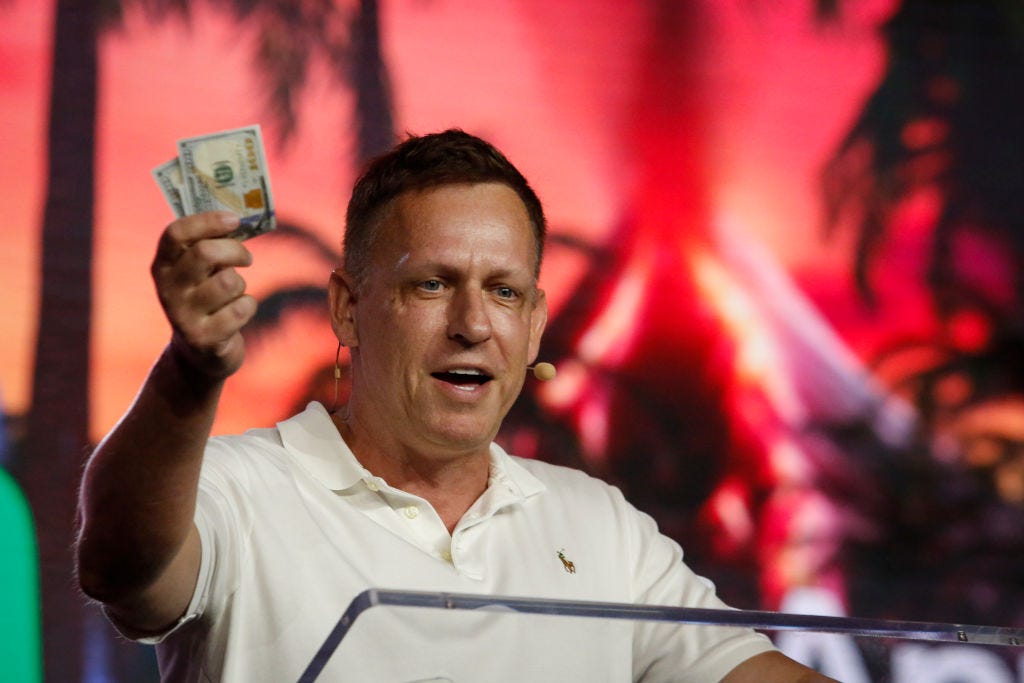
A data leak last week provided a fresh glimpse into how far-right billionaire Peter Thiel, the cofounder of Palantir and PayPal, has sought to extend his influence and cultivate the powerful. The leak unmasked the membership and attendee lists for a discreet social network cofounded by Thiel that serves as a way for wealthy tech figures to mingle with members of the political, military, and media elite.
Dialog, an organization launched in the mid-2000s by Thiel and tech entrepreneur Auren Hoffman, regularly hosts off-the-record, invitation-only conferences of a kind not unlike those held by the Bohemian Club, the Bilderberg Group, and World Minds. While Dialog’s events are organized around lectures, networking at lavish and secluded resorts — including at Sundance in Utah, a Ritz-Carlton in mountainous Southern Arizona, and a luxury hotel on a private Venetian island — is the primary function.
It is unclear how many of the people named in the leak are actively involved with Dialog, how recently they attended events, or whether they were merely invited. However, the leak, which was first identified by Swiss hacktivist maia arson crimew, exposed a list of members and guests that included trillionaire Elon Musk and billionaires Eric Schmidt, the former CEO of Google; Reid Hoffman, the cofounder of LinkedIn; and Greg Brockman, the president of OpenAI.
Also named were numerous figures working in or around the Trump administration: “unofficial” White House advisor Jared Kushner, Treasury Secretary Scott Bessent, White House staff secretary Will Scharf, and National Science Foundation nominee Jim O’Neill. Elected representatives from both parties were listed as well, including Senator Ted Cruz (R-TX) and Senator Cory Booker (D-NJ) — and a pair of potential 2028 Democratic presidential candidates, Governor Wes Moore (D-MD) and Governor Jared Polis (D-CO). (Booker, Moore, and Polis have all denied active involvement with Dialog.)
Hoffman and a representative for Thiel did not immediately respond to requests for comment.
Dialog appears intent on growing its influence in Washington. Last year, Axios reported that the organization planned to open a campus in the D.C. suburbs.
Another notable name revealed in the leak was that of Air Force General Alexus Grynkewich, commander of US European Command and the second-ranking military leader in NATO. Data from the leak showed that Grynkewich has attended Dialog events since 2021.
Among the media figures linked to Dialog were New York Times columnists Ezra Klein and Bret Stephens, podcaster Sam Harris, and Steven Pinker, the Harvard psychologist who assisted with Jeffrey Epstein’s legal defense following his 2006 arrest for sexually abusing underage girls.
On X, Klein acknowledged attending Dialog conferences in 2018 and 2022 but claimed he was not a member and “never saw or talked to” Thiel. “I would not have described it as a secret or a society,” he wrote, before suggesting that “credulous” actors were attempting to turn the conference into “a new conspiracy theory.”
“Build-a-Cult”
The Dialog lists named government officials alongside tech figures whose companies those same officials help fund, regulate, or oversee
Thiel, for instance, is the chairman of Palantir, an AI software and data management company that has billions of dollars in contracts with the US Army and Department of Homeland Security (DHS). Dan Driscoll, the secretary of the Army, was listed in the Dialog leak, as was Rep. Jim Himes (D-CT), the ranking member of a House committee that oversees the DHS and military intelligence.
Reporting from Wired noted that Dialog’s upcoming August retreat, to be held in Ireland, will focus on an eclectic set of topics. Titles of the lectures include “Navigating WWIII,” “Battlefield Technologies,” “Money (Does?) Buy Happiness,” “Bring Back Nuclear,” and “How’s Your Sex Life?” (A presentation on sex might seem out of place, but Dialog operates an intra-network dating service for participants who declare they are “looking for love,” per Wired.)
Another session on the schedule, titled “Build-a-Cult,” will be hosted by the co-founder of Pray.com, a Christian social networking platform. But it could, in theory, also be presented by Thiel, who has urged aspiring tech founders to run their startups “like a cult.”
“In the most intense kind of organization, members abandon the outside world and hang out only with other members,” he wrote in a 2014 essay for Wired. “We have a word for such organizations: cults.”
And in his best-selling business advice book, published the same year, Thiel lamented the lack of cults in 21st-century America. “Today, you can’t start a cult. Forty years ago… large numbers of people thought they could join some enlightened vanguard that would show them the Way,” he wrote in Zero to One: Notes on Startups, or How to Build the Future. “Very few people take unorthodox ideas seriously today, and the mainstream sees that as a sign of progress. We can be glad that there are fewer crazy cults now, yet that gain has come at great cost: we have given up our sense of wonder at secrets left to be discovered.”
“Thiel LOVED the secret society idea”
Dialog and some of Thiel’s other networking operations also attracted the attention of Jeffrey Epstein, the late sexual predator.
In 2012, email correspondence to and from Epstein, which was released by the Justice Department, shows that he encouraged Harvard physicist Lisa Randall to attend a Dialog event. “Sundance is nice „ go,” Epstein wrote after Randall forwarded him an invitation and asked whether that year’s Dialog conference would be “worthwhile.”
The following year, biotechnology executive Boris Nikolic, a close associate of both Epstein and Bill Gates, recommended that Epstein follow a discussion on the geopolitical ramifications of Bitcoin scheduled at a Dialog retreat in Turkey. “You should have someone print you various materials in links below,” wrote Nikolic. “It has a lot of interesting info/comments. You probably already know most of it but just in case.”
Then, in 2014, Ian Osborne, a British investor and courtier to billionaires and politicians, emailed Epstein to complain about Dialog, writing, “Same shit. Peter doesn’t even attend. I will tell him that he should stop them using his name.” According to the Financial Times, Osborne hosts his own annual conferences for tech elites.
Two years later, Epstein also appeared to pan Dialog. “peter thiel LOVED the secret society idea,” he wrote to Joi Ito, who was then the director of the MIT Media Lab. “he has done alot of work on the concept. all failed so far.”
Thiel first met Epstein six years after he pleaded guilty to soliciting prostitution from a minor. The two communicated frequently, including in person, and Epstein held a partnership stake in one of Thiel’s investment funds.
“A deadly race between politics and technology”
Along with co-founding PayPal and Palantir, the 58-year-old Thiel has made a string of successful venture investments, including early bets on Facebook, LinkedIn, and SpaceX. He has also managed to pick winners in the political arena, donating to Trump in 2016. He then used his bought influence to set up a 2021 meeting between Trump, JD Vance, and himself, which helped Vance secure a Senate seat and ultimately the vice presidency. (Thiel, whose relationship with Vance dates back to 2011, hired him to work for his venture capital firm, helped him cofound his own investment firm, and donated millions of dollars for his Senate race.)
Whatever gains Thiel has secured from founding Dialog and other secretive gatherings are more opaque. What’s clear, however, is that both Washington and Silicon Valley have moved progressively closer to his once-fringe political views.
In 2001, for instance, Thiel described PayPal as a digital tool for “the erosion of the nation-state” and has long supported cryptocurrencies on libertarian grounds. Today, Trump and many congressional Republicans have embraced cryptocurrencies and promised to keep the industry unregulated. (David Sacks, formerly of PayPal and one of Thiel’s closest associates, served as Trump’s crypto and AI czar from January of last year until March.)
More recently, Thiel’s self-serving messaging on the use of AI to project American power and defeat China has become a standard talking point for Trump and other conservatives whose feelings toward Big Tech have flipped from hostile to harmonious. Speaking at the National Conservatism Conference in 2019, Thiel accused Google of “seemingly treasonous” actions by opening an AI lab in China and called for Silicon Valley to help empower the US against its enemies. Much of Trump’s second term has been marked by similar national security rhetoric, which the administration has used to lobby for the frenzied construction of AI data centers. Thiel holds an equity stake worth billions of dollars in Palantir, a top AI software provider for the Pentagon.
And yet, in 2009, shortly after the inauguration of Barack Obama, a then-dejected Thiel feigned that he was preparing to abandon domestic politics altogether and that “freedom” would have to be found elsewhere — possibly on the internet, or in the “limitless frontier” of outer space, or on a seasteading colony somewhere in the ocean. “I no longer believe that freedom and democracy are compatible,” he wrote in an essay for the libertarian Cato Institute, adding that “welfare beneficiaries” and women’s suffrage “have rendered the notion of ‘capitalist democracy’ into an oxymoron.”
“We are in a deadly race between politics and technology,” he continued. “...The fate of our world may depend on the effort of a single person who builds or propagates the machinery of freedom that makes the world safe for capitalism.”
Time for everyone to stop using PayPal!
Yet another, garden variety megalomaniac puffed up by too much money and unlimited self-aggrandizement, but ultimately animated by only the sheer terror of being forced to face what he can't pay to avoid -- his own mortality.