

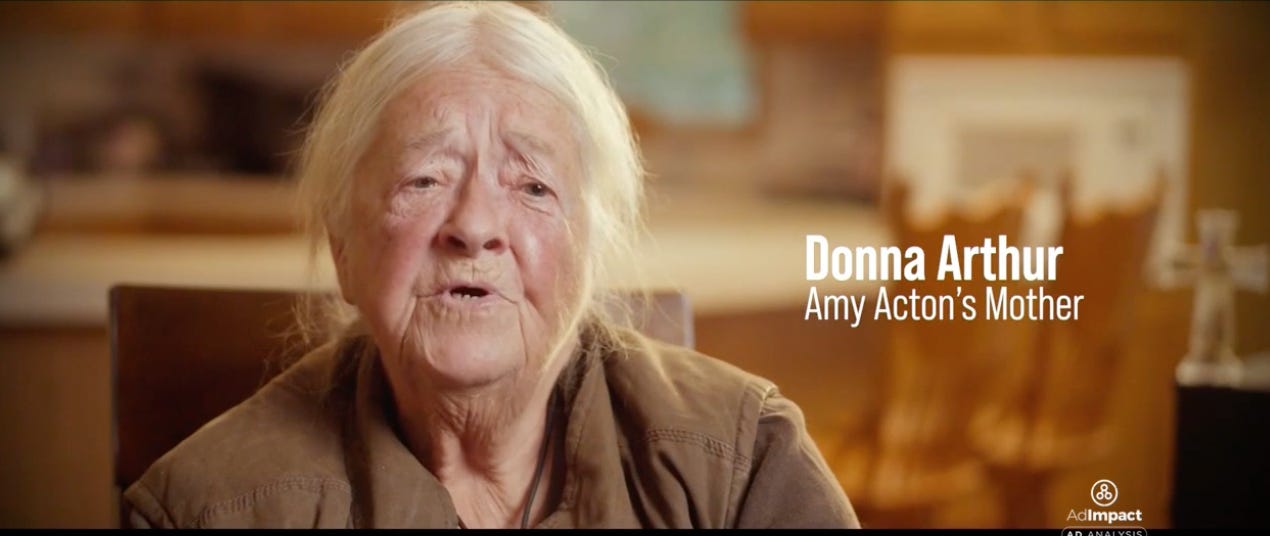
Appearing on Fox News Monday, billionaire Vivek Ramaswamy, the Republican gubernatorial nominee in Ohio, defended his campaign’s now infamous attack ad featuring his opponent’s estranged mother.
In airing the ad, which has been widely condemned for weaponizing child sexual abuse, Ramaswamy said he didn’t intend to “start a fight” — he was merely trying to “finish” one.
From ages nine to 12, Amy Acton, the race’s Democratic nominee, was allegedly raped and molested by her stepfather, Cledith Arthur. When charges were brought against him, Acton’s mother, 82-year-old Donna Arthur, sided with her daughter’s abuser. Cledith Arthur, now deceased, escaped justice by fleeing Ohio for Pennsylvania with Acton’s mother, who abandoned her two young children.
Last week, Donna Arthur reappeared to again attack her daughter’s integrity — this time in the ad for Ramaswamy’s campaign, where she called Acton a “liar” and urged Ohioans not to vote for her.
Defending the ad on Fox & Friends, Ramaswamy claimed fair play. “They’ve attacked me!” he said. “They’ve defamed my mother to media silence. It’s unbelievable.”
Just how had Acton attacked his mother? Ramaswamy didn’t specify. There might be a reason for his ambiguity.
The Ramaswamy campaign did not immediately respond to a request for comment.
How Ramaswamy’s mother helped him
In 2015, Ramaswamy, then 29, made history with help from his mother. His biotechnology company, Axovant, raised $315 million in a record-setting initial public offering. Axovant’s only asset was intepirdine, an experimental Alzheimer’s drug GlaxoSmithKline (GSK) sold for a paltry sum after it failed multiple Phase 2 clinical trials.
At Axovant, he employed his mother, Geetha Ramaswamy, who — despite lacking relevant statistical qualifications — reworked data from intepirdine’s failed trials to make the drug look like a more promising dementia treatment, as previously reported by Oligarch Watch.
On the day of its IPO, Axovant cited the supposedly “robust” clinical analysis in a regulatory filing meant to inform investors of potential risk factors and conflicts of interest.
But the company failed to disclose that Ramaswamy’s own mother had co-authored the rosy statistical analysis. (The filing did note that Geetha Ramaswamy was employed by Axovant and had been granted stock options. But her familial relationship appeared only in boilerplate disclaimers, not alongside the statistical data Axovant advertised to investors.)
Although Geetha Ramaswamy had worked as a geriatric psychiatrist, she did not have relevant expertise in biostatistics, statistical analysis, or bioinformatics. Her title at Axovant was vice president of medical and scientific strategy.
In its Securities and Exchange Commission prospectus filing, Axovant said its “statistician” used data from one of the unsuccessful GSK studies to create its own “completer analysis,” meaning it included only data from participants who finished the 48-week trial. That method of analysis has long been criticized by leading biostatisticians for producing incomplete and potentially misleading pictures of patient outcomes.
Axovant, nonetheless, used it to breathe new life into a years-old clinical trial that intepirdine had failed.
The company also pitched a new set of primary endpoints — measures of the drug’s efficacy in patients — departing from the primary objective set by the study’s original researchers. The change, Axovant claimed, was “a more appropriate” approach. It also had the upside of making intepirdine suddenly appear more viable as a treatment for patients with mild-to-moderate Alzheimer’s disease.
Geetha Ramaswamy’s role in reworking the data was only made public weeks after the company’s IPO, when her co-analyses were published in an Alzheimer’s journal.
Axovant’s share price ultimately plummeted in 2017 after intepirdine failed its Phase 3 trial. By then, Ramaswamy was largely insulated from the crash, having monetized his indirect stake through a well-timed $1.1 billion investment from SoftBank.
Some investors — including the retirement fund for Ohio teachers — weren’t so lucky, suffering heavy losses in the aftermath.
By accusing his opposition of unfairly attacking his mother, Ramaswamy appears to be referring to the Axovant episode, as the Acton campaign has cited Oligarch Watch’s reporting on Geetha Ramaswamy and her work for the company.
In Ramaswamy’s telling, pointing out the suspect role his mother played at Axovant is roughly equivalent to airing a political ad with a woman who defended her own daughter’s alleged rapist.
Teachers’ retirement funds and other losers
In 2023, when Ramaswamy left his unprofitable biotech business to launch a career in Republican politics, Forbes described him as a newly minted billionaire. Several fellow billionaires are backing his bid for Ohio’s governorship, including Elon Musk, who gave $5 million to a political action group supporting Ramaswamy.
Left in the wake of Ramaswamy’s personal financial success were numerous losers.
Before Axovant’s crash, STRS Ohio, the state’s teachers’ retirement fund, held shares valued at $744,000. That position fell by $540,000 following the sell-off triggered by intepirdine’s final clinical trial. By December, the fund had liquidated its Axovant position as the stock traded in the single digits.
Among the biggest losers was the California State Teachers’ Retirement System, which lost more than $1,228,000 from its Axovant holdings, while the Illinois Teachers Retirement System lost $250,000.
The Florida Retirement System lost $245,000. The New York State Common Retirement Fund lost $445,000. And the State of Wisconsin Investment Board lost $437,000.
A similar story played out in early 2021 at Immunovant, a company Ramaswamy founded to market IMVT-1401, an experimental pharmaceutical meant to treat Graves’ eye disease. In February of that year, Immunovant paused clinical trials after patients showed elevated cholesterol levels, triggering a major crash.
STRS Ohio, which held 9,100 Immunovant shares valued at $420,000, sold its holdings after the crash. Millions of dollars’ worth of combined losses tied to Immunovant were also reported by the California Public Employees’ Retirement System, the California State Teachers’ Retirement System, the New York State Common Retirement Fund, and the Virginia Retirement System.
Congratulations, Oligarch Watch, for this outstanding work!!
Payback? What is he, five?