

SpaceX engine explodes as Musk targets $2 trillion IPO
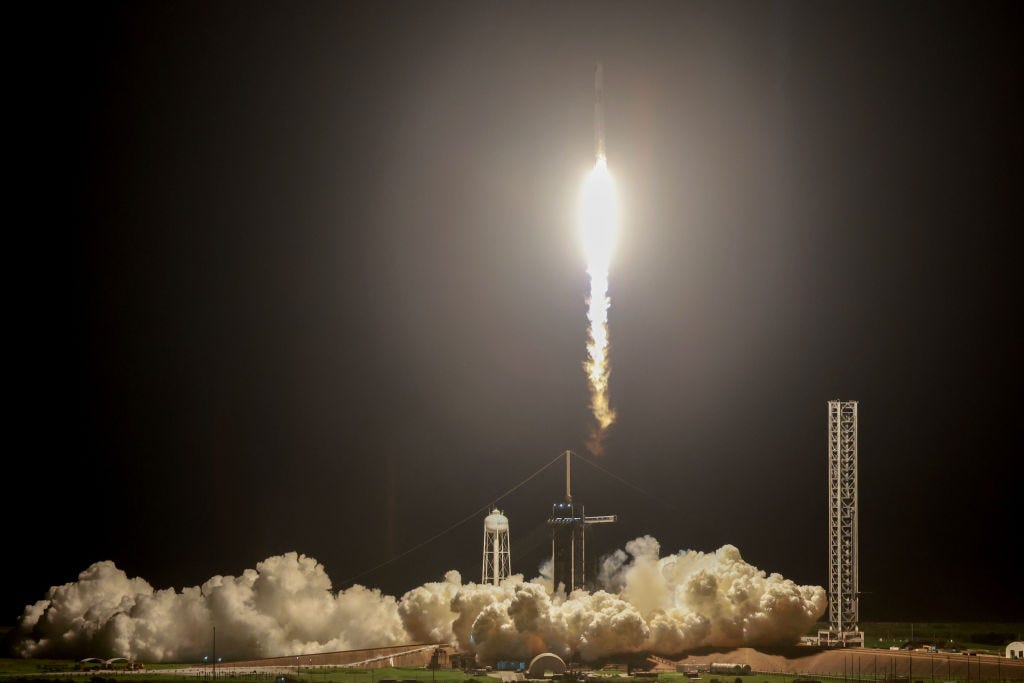
An engine for SpaceX’s Starship rocket burst into flames on Monday during a firing test at the company’s facility in McGregor, Texas. The incident occurred a few days after SpaceX CEO Elon Musk announced that the next test flight of his experimental, 403-foot-tall Starship would be delayed for the third time this year. After initially scheduling it for March, Musk said SpaceX now plans to conduct the first Starship test flight of 2026 in early to mid-May.

If SpaceX sticks to that timeline, the test launch would occur about one month before the company makes its initial public offering, where it is now targeting a $2 trillion valuation.
That’s roughly five times what the company was worth last year—an increase in valuation that reflects less the success of its core business and more the extreme frothiness of the artificial intelligence market and Musk’s attempt to quickly pivot his decades-old rocket company into a vehicle for investor speculation. Musk, who’d long insisted he would never take SpaceX public—at least not until it had established a Mars colony—appears to be trying to beat AI rivals Anthropic and OpenAI to the public markets as early as this summer.
SpaceX has already suffered several explosive accidents and setbacks during its previous 11 Starship tests, so timing the launch so closely with its IPO could be risky. Musk has made Starship key to all of SpaceX’s long-term goals, including plans to launch larger Starlink satellites, orbital AI data centers, and a NASA mission to return astronauts to the lunar surface. Starship is also part of Musk’s fantastical plan to operate a satellite factory and an accompanying launch catapult on the Moon.
If the Starship project continues to suffer setbacks, all of those plans will be jeopardized — along with SpaceX’s goal to become one of the five most valuable companies by market capitalization. That said, retail investors have consistently shown a willingness to buy into Musk’s companies, even when they repeatedly fail to follow through on core promises.
Courting those retail investors appears to be a key strategy in boosting SpaceX’s market capitalization. During a Monday meeting with bankers, Bret Johnsen, the company’s chief financial officer, indicated that SpaceX will set aside “a large portion of shares for retail investors and will host 1,500 of them at an event in June following the IPO roadshow launch,” according to Reuters.
“Those are folks that have been incredibly supportive of us and of Elon for a long time, and we want to make sure that we recognize that,” Johnsen said, referring to retail investors.
This Week in Musk:
xAI, the Musk-led artificial intelligence company that recently merged with SpaceX, has mandated that banks, law firms, and advisory companies must purchase subscriptions to its Grok chatbot before they can participate in the SpaceX IPO. (New York Times)
xAI has placed an indefinite pause on its promise to build a water-recycling plant near Memphis, Tennessee, where its data centers consume huge amounts of freshwater from the same aquifer that provides drinking water to residents in the region. Musk has claimed the water-recycling project will resume once xAI ensures that its Colossus 2 data center facility is “extremely stable.” (Daily Memphian)
Private security guards employed by Musk were deputized as federal agents last year, during the centibillionaire’s time leading the White House’s Department of Government Efficiency. (NBC News)
JP Morgan analyst Ryan Brinkman wrote in an investor note that Tesla stock could fall by 60% amid the company’s dwindling share of the electric-vehicle market and its failure to live up to its autonomous-driving claims. The analysis comes as Tesla reported its weakest quarter since early 2025 and remains stuck with a ballooning inventory. Fewer Americans are buying EVs following the expiration of a federal tax credit that subsidized industry sales. (Electrek)
Intel, a leading U.S. chipmaker, will “work closely” with Musk on his dream to build by far the largest chip-fabrication plant in the world, according to the company’s chief executive. The specifics on how Intel will partner with Musk remain very murky. (Wired)
In his lawsuit against OpenAI and Sam Altman, Musk has demanded Altman’s removal from his leadership roles at the company. (CNBC)
California Gov. Gavin Newsom claimed in an interview with Bloomberg that Musk called him for help a year after moving the bulk of Tesla’s operations from California to Texas. “He said, ‘I’m surprised you’re picking up the phone. I may actually ask you for some help… [because] I can’t find the talent in Texas. Don’t say a word,’” Newsom said of his call with Musk. (Bloomberg)
Meta releases new AI model after billions in spending
On Wednesday, Meta launched a new large language model called Muse Spark, its first major AI release since Mark Zuckerberg funneled billions of dollars into the company’s Superintelligence Labs division.
The chatbot for the model is accessible through Meta’s dedicated AI website and app, and the company plans to integrate it across Instagram, Facebook, WhatsApp, Threads, and its line of smart glasses. “Muse Spark is purpose-built for Meta’s products,” the company said. “It will power a smarter and faster Meta AI, and over time unlock new features that cite recommendations and content people share across Instagram, Facebook, and Threads.”
In a blog post announcing the model, Meta advertised it as “especially valuable for health,” despite large language models being notorious for generating medical misinformation. “Meta AI is now able to help you navigate health questions with more detailed responses, including some questions involving images and charts,” the company wrote. “Health is one of the top reasons people turn to AI, so we worked with a team of physicians to develop the model’s ability to provide helpful information on common health questions and concerns.” Meta’s new focus on delivering AI-generated medical advice follows the recent releases of ChatGPT Health by OpenAI and Claude for Healthcare by Anthropic.
Muse Spark is the first model Meta has released since the embarrassing rollout of Llama 4 last spring. That failure led Zuckerberg to spend billions of dollars hiring engineers and researchers and building the company’s computational infrastructure. Meta spent $14.3 billion alone to acquire a 49% stake in Scale AI and hire its cofounder, Alexandr Wang, to lead Meta Superintelligence Labs.
One of Meta’s future goals is to provide so-called “personal superintelligence,” in which AI “agents” could perform unsupervised tasks for human users. Relying on agentic AI systems remains an experimental and often fraught endeavor. Last month, Summer Yue, a director at Meta Superintelligence Labs, said that her AI agent began indiscriminately erasing her email inbox, ignoring direct commands. “I couldn’t stop it from my phone. I had to RUN to my Mac mini like I was defusing a bomb,” she wrote.
This Week in Zuck:
OpenAI has accused Mark Zuckerberg and Meta of “colluding” with Elon Musk as he “sought to dig up incriminating information on [OpenAI CEO Sam] Altman.” The company made the claims in a letter to California Attorney General Rob Bonta, asking him to investigate the alleged “anti-competitive” and “improper” conduct. OpenAI executive Chris Lehane also accused Zuckerberg and Musk of “turning to conduct and approaches that we do think are really highly questionable and sharply worthy of investigation.” (Sacramento Bee)
Meta has removed ads on its platforms placed by attorneys who are seeking clients who may have been harmed on Facebook and Instagram when they were underage. The move comes shortly after Meta lost a pair of jury verdicts for harming children on its platforms. (Axios)
The Delaware Chancery Court gave final approval to the $190 million settlement from Meta over data privacy violations related to the Cambridge Analytica scandal. (Bloomberg Law)
A former Meta engineer is facing a police investigation in London for illegally downloading 30,000 private images shared by Facebook users. (BBC)
Ellisons secure $24 billion from Middle Eastern countries for Warner deal
To fund its $110 billion acquisition of Warner Bros. Discovery (WBD), Paramount Skydance has secured $24 billion in state funding from Saudi Arabia, Qatar, and Abu Dhabi, according to the New York Times. $12 billion of the funding will come from Saudi Arabia’s Public Investment Fund.
American oligarchs — particularly those whose fortunes come from tech — regularly do business with the governments of Qatar, Saudi Arabia, and the UAE, despite the rampant human rights abuses and modern slavery that take place in all three countries. Seven Democratic senators have raised separate concerns about Gulf countries using their funding to influence news coverage at CBS, owned by Paramount Skydance, and CNN, owned by WBD.
Centibillionaire Larry Ellison, whose son, David Ellison, owns and operates Paramount Skydance, has personally guaranteed over $40 billion in funding for the deal, although he has said he will offload some of that to other parties. WBD shareholders plan to hold a final vote on the sale to Paramount Skydance at a meeting on April 23.
In other Ellison-related news, Paramount President Jeff Shell has stepped down following a bizarre legal dispute with a professional gambler and self-styled fixer. Shell, a former NBCUniversal executive, had been a key member of David Ellison’s inner circle during Skydance’s acquisition of Paramount, the Los Angeles Times reported. It was Ellison who had given him a career lifeline in 2024 shortly after Shell was forced out of NBC over claims that he had sexually harassed a CNBC anchor.
Ellison has a fixation on renewing the media careers of men who have been accused of sexual misconduct. His other reclamation projects include director Brett Ratner, screenwriter Max Landis, and animator John Lasseter.
Secretive AI company owned by Bezos poaches engineer from OpenAI
Project Prometheus, the moniker for a new AI startup owned by Jeff Bezos, has hired Kyle Kosic, an engineer who cofounded Musk’s xAI and most recently worked for OpenAI. Bezos reportedly plans to use Prometheus to both develop automated manufacturing technologies and acquire existing aerospace, defense, and chip-fabrication companies. From The Financial Times:
Prometheus, meanwhile, has hired hundreds of staff at its headquarters in San Francisco and in its offices in London and Zurich. It has focused on hiring engineers, AI researchers and people with experience in “building out massive infrastructure projects”, one person familiar with its hiring said.
The start-up, launched by Bezos last year, is working on AI systems that can operate in the physical world and go beyond the language-based systems behind chatbots such as ChatGPT or coding tools such as Claude Code.
Project Prometheus declined to comment.
The company is particularly focused on the industrial sector. It envisions a model that can understand the laws of physics and is trained on data from specific domains, such as jet engine design, one person close to the company said.
They added that the company had already “assembled the largest corpus of data on engineering” and how such systems work.
To fund Prometheus, Bezos has sought sovereign wealth backing from Gulf countries and Singapore.
This Week in Bezos:
After threatening to severely cut the shipping work it offloads to the U.S. Postal Service, Amazon has reached a new deal that would see its package volume with the federal agency reduced by just 20%. The deal, which could still cost USPS billions of dollars in lost revenue annually, now awaits approval from the Postal Regulatory Commission. (USA Today)
The National Labor Relations Board has ordered Amazon to recognize and bargain with the Teamsters over unionization efforts at one of the company’s warehouses on Staten Island. (Washington Post)
Amazon CEO Andy Jassy defended the company’s $200 billion AI-related spending frenzy, writing in a letter to shareholders, “We’re not going to be conservative in how we play this — we’re investing to be the meaningful leader, and our future business, operating income, and [free cash flow] will be much larger because of it.” (CNBC)
Oligarch Roundup
OpenAI CEO Sam Altman accused of consistently “lying” in expose. The New Yorker published a lengthy investigation this week on Altman that includes a number of accusations from colleagues and peers. In one internal memo, which was related to Altman’s short-lived removal by the OpenAI board in 2023, he was accused of exhibiting “a consistent pattern of… lying.” Carroll Wainwright, a former OpenAI researcher, also suggested that Altman has a pattern of slippery behavior, saying, “He sets up structures that, on paper, constrain him in the future. But then, when the future comes and it comes time to be constrained, he does away with whatever the structure was.” And one unnamed Microsoft executive warned that “there’s a small but real chance [Altman is] eventually remembered as a Bernie Madoff- or Sam Bankman-Fried-level scammer.” (New Yorker)
Google Search is spreading AI misinformation at a colossal scale. The seemingly authoritative AI summaries, which are automatically embedded at the top of every Google Search, are accurate only 91% of the time, according to an analysis by Oumi, an AI startup founded by former Google and Apple engineers. There are five trillion Google searches every year, meaning the search engine is likely sharing hundreds of billions of incorrect AI responses annually. Anecdotally, a 9% error rate seems like a fairly conservative estimate; Google’s AI summaries regularly produce information that it assumes users want to read, even if there is no supporting factual basis. (New York Times)
Maine set to become first state to ban new data centers. Citing environmental and energy concerns, the state’s Democratic-led House passed a bill last month that would freeze the construction of any new major data center projects until late 2027. The bill is expected to pass the Senate and be signed into law by Democratic Gov. Janet Mills. Similar efforts are gaining popularity around the country. In Port Washington, Wisconsin, voters passed a first-of-its-kind referendum pausing future data center development in the city. (Wall Street Journal)
Thank you for helping me make sense of this oligarchical age we find ourselves in. It never fails to amaze me of how fast in my lifetime alone the American billionaire class evolved and convinced the masses that their world of giving scraps to dogs is the world we want to live in. The oligarchs of the gilded age, where one man, Rockefeller, owned 10% of the nations wealth while 10% of women died in childbirth and 10% of children were dead by age 2, should never have been allowed to happen again, and yet here we are a century later with centibillionaires generating AI to make us stupid while measles makes a comeback with white Christofascism and more children live in poverty. Gosh I love progress.
Like his cars.