


Lacking steering wheels and brake pedals, Tesla’s new Cybercab model debuted on Thursday, with dozens of the vehicles hitting the streets of Austin, Texas, as part of a pilot program.
Tesla CEO Elon Musk hailed the launch as the start of a “literal golden era of transport,” a reference to the model’s gaudy gilded coloring. Cybercabs “are designed and built for maximally efficient autonomous operation,” he wrote on X.


Despite Musk’s insinuation that Cybercabs are “autonomous,” the vehicles still appear to rely on the same human teleoperators that Tesla’s small and experimental “Robotaxi” fleet has used for more than a year.
There have been incidents in the last month involving Tesla’s 200 Robotaxis deployed across Texas and Florida. One of the vehicles rammed through street bollards; another appeared lost while driving a customer on a winding ride that ended miles from their destination.
There have also been two recent fatal crashes in which Tesla drivers using the company’s automated driving systems died after their respective vehicles came to sudden stops in the middle of freeways in Arizona and Florida.
Meanwhile, after industry leader Waymo completed 200 million miles of “Fully Autonomous” rides last month, a company executive published a “lessons learned” blog post last week arguing that Tesla’s camera-only hardware model is not enough.
“For years, there’s been a debate over whether cameras alone could solve full autonomy. Now, after more than 200 million real-world miles, the data is clear: safe, fully autonomous operations at scale require” hardware redundancies, including lidar and radar sensors, Waymo’s Srikanth Thirumalai wrote. (Waymo has nearly 3,900 driverless vehicles in service.)
This Week in Musk:
Elon Musk’s America PAC disclosed that it spent $800,000 in August to support Republican congressional candidates, with much of the funding going toward Senate races in Texas and Maine. The New York Times previously reported that Musk has authorized his PAC to spend more than $100 million on the midterms. (New York Times)
Last year, the Musk-led Department of Government Efficiency initiative cut funding for the US Agency for International Development’s program to pinpoint and track landslide risk zones in Nepal. Those cuts are receiving renewed attention following the loss of more than 1,200 lives in recent flash flooding in Nepal. (CNN)
On X, Musk again shared his thoughts on Jewish “DNA” and whether Jewish people should be considered white. “I’ve met so many people who look extremely European in every way and tell me they’re Jewish,” he wrote. “Well, maybe there are a few OG ‘Jewish ACTG’ [DNA] sequences in there somewhere, but clearly not many!” (X)
xAI, a subsidiary of Musk’s SpaceX, is preparing to build its fifth data center in the Memphis, Tennessee, area. The latest site is located in Southaven, Mississippi, across the street from xAI’s toxic power plant. (Fox 13)
SpaceX issued an apology on Thursday after Grok, xAI’s chatbot, went offline after an outage at one of the company’s Memphis data centers. “We are taking corrective action to ensure this does not happen again,” Musk said. (X)
Examining SpaceX’s planned $100 billion launch facility in Louisiana, Morgan Stanley analyst Adam Jonas noted that investors are wondering where the funding will come from. Taxpayer money is one “plausible” answer to that question, according to Quilty Space analyst Kimberly Siversen Burke, as Donald Trump recently signed an executive order calling for huge increases to US launch capacity. (Market Watch)
Last month, Ukrainian President Volodymyr Zelenskyy issued a decree awarding the country’s Order of Freedom to Musk. The charm offensive was yet another effort by Zelenskyy to persuade Musk to allow Ukraine to use SpaceX’s Starlink satellites to carry out strikes inside Russia. Musk, however, remains unmoved. (Observer)
Did Meta get off too easy?
Some experts and commentators believe that Meta got off too lightly in its $17.1 billion deal to settle claims brought by 47 states who said its platforms harmed the mental health of minors, including through addictive design elements.
In an interview with Politico, Arturo Bejar, a former Facebook safety employee-turned-whistleblower, said the settlement missed the mark by allowing Meta “to define harm as whatever they define it as.”
“I’ve spoken to around 40-something bereaved parents,” he added. “Social media recently played a meaningful role in their kids’ death, and these changes would not have saved one of those lives if they had been in place.” (The most consequential change that Meta agreed to is a two-hour daily time limit for underage users on Instagram and Facebook.)
Bejar also urged the states to use the settlement money to research how young people are harmed through their use of social media platforms. Prosecutors could then use that information, he said, to pursue further litigation or legislation as needed.
Meta, which settled eight days into the trial, paid a fraction of its annual revenue to shake a legal albatross that has weighed on it for years. As a result, the company’s share price is up 6.77% over the last five days.
This Week in Zuck:
During a call with Donald Trump last month, Zuckerberg reportedly lobbied against the White House’s push to create an AI industry self-regulatory organization (SRO). One source told Politico that Zuckerberg encouraged Trump to appoint regulators who lean toward a hands-off approach to AI. The White House has spent weeks weighing an executive order to create an SRO for AI — one not unlike the Financial Industry Regulatory Authority — but has yet to follow through on the plan amid internal disagreement and objections from the private sector. Such a body would be responsible for reviewing new models from leading American AI companies before they are approved for public use. (Politico)
Meta has taken down numerous advertisements in India that used pornographic material to entice Instagram and Facebook users to unknowingly download financial malware. Government officials described the ads as “malicious Android applications masquerading as pornography apps.” It was the company’s latest advertising scandal in the country. In July, India ordered Meta to remove ads on its platforms promoting the sale of child sexual abuse material. (Reuters)
In Newton County, Georgia, homeowners are suing Meta for allegedly contaminating the local water supply during construction of its $1 billion data center. (Atlanta Journal-Constitution)
An amendment to a class action lawsuit against Meta opens the door for bystanders to join if they were nonconsensually filmed by a pair of the company’s AI smart glasses. “This amended complaint adds the human beings on the other side of the glasses to the story,” said co-lead counsel Ryan Clarkson. “People having intimate sexual encounters, children being bathed by parents, or having their diapers changed by grandparents, people showering, changing clothes, and breastfeeding — who never agreed to surrender their privacy because someone near them bought a pair of glasses.” (Futurism)
FTC and 22 states accuse Amazon of illegally inflating ad prices
The Federal Trade Commission (FTC) and 22 state attorneys general filed a lawsuit on Monday accusing Amazon of surreptitiously manipulating prices for millions of sellers that paid to advertise on the world’s largest e-commerce platform.
The agency said the alleged scheme likely enabled Amazon to extract “tens of billions of dollars from its unwitting advertising customers,” including through undisclosed surcharges imposed on companies that participated in its advertising placement auctions. Winners of the auctions ensure that their products or brands appear before customers who enter a relevant search query on Amazon’s platform.
“Amazon has represented to prospective advertisers for years that Amazon runs ‘second price’ auctions where the winner of the auction would only pay ‘one cent more than the next highest bidder’ for each successful bid for an advertising keyword,” the FTC said in a press release. “However, in practice, the complaint alleges that Amazon has charged its Sponsored Products advertisers their own winning bid close to 80% of the time and has effectively converted its nominally ‘second price’ auction into a first price auction.”
In the lawsuit, lawyers for the FTC claimed that Amazon has admitted to using “invented” auction participants to place “shill bids,” thus raising prices on real companies that bought ads.
Amazon has denied any wrongdoing and said the complaint is based on a “flawed premise.”
“The FTC’s claim fundamentally misunderstands how advertisers operate. Advertisers adjust bids based on real-world performance, not descriptions of auction mechanics,” the company added in a statement.
The latest FTC suit against Amazon was filed less than 11 months after the company agreed to a $2.5 billion settlement with the government over claims that it hindered customers from canceling their Prime memberships.
This Week in Bezos:
Citing unfair labor practices, Amazon workers represented by the Teamsters staged a one-day strike on Wednesday at the company’s largest US warehouse in Riverside, California. “Members of Teamsters Local 1932 were forced into a work stoppage to protest Amazon’s illegal conduct and retaliation against workers advocating for safer working conditions,” the union said. (Teamsters)
Through Amazon, Jeff Bezos has played a defining role in popularizing and profiting from so-called “clothing hauls,” or when consumers buy heaps of cheap clothes — often made by exploited workers — with the intention of wearing them a few times and then throwing them away. Amazon even has a dedicated “Haul” store to compete with Temu, a rival retailer in the made-to-discard textile industry. However, Bezos and his wife, Lauren Sanchez, are now using their environmental nonprofit to fund a project being billed as “the future of sustainable fashion.” (The Cut)
Blue Origin, Bezos’ aerospace and satellite company, has secured a NASA contract worth up to $700 million to produce a Mars telecommunications orbiter. “The award marks a milestone in NASA’s strategy to expand communications and navigation services beyond Earth and the moon, establishing the foundation for sustained exploration of Mars in the coming decades,” the agency said on Tuesday. (Space.com)
Amazon plans to launch Prime Air, its flying drone delivery service, in 500 communities across the US by the end of the year. But people living in some of the service areas have raised safety and privacy concerns. “I’m worried that even if I never have a drone delivery in my front yard or backyard, my front yard and backyard [are] visible to my neighbors,” Scott Lebow, a Richmond, Virginia, resident, told WRIC. “So if their drone is getting delivered and it spies something across the fence, I don’t know where that data is being stored. I don’t know what it’s being used for.” There have also been safety concerns raised after an airborne Amazon drone dropped a package into a person’s pool in Texas last month. (WRIC)


White House backs OpenAI in copyright lawsuit with New York Times
In a Tuesday filing, lawyers for the Trump administration defended OpenAI’s nonconsensual use of copyrighted material from the New York Times and other publishers, writing, “The United States has a strong interest in this court rejecting any argument that training LLMs on copyrighted texts violates copyright law.”
The Times and other publishers have sued OpenAI for alleged copyright violations stemming from the ChatGPT maker’s reliance on a vast amount of protected material to train its models. OpenAI claims its actions are covered by fair use doctrine.
In an advisory brief, the White House once again used a “national security” pretext to justify its vehement support for an American artificial intelligence company whose leadership has donated heavily to Donald Trump.
“AI dominance is critical to promote national security, prosperity, and economic mobility for all Americans,” US Associate Attorney General Stanley Woodward wrote in a statement. “This Administration will never let our Nation be at a disadvantage relative to our foreign adversaries based on a plainly incorrect understanding of copyright law.”
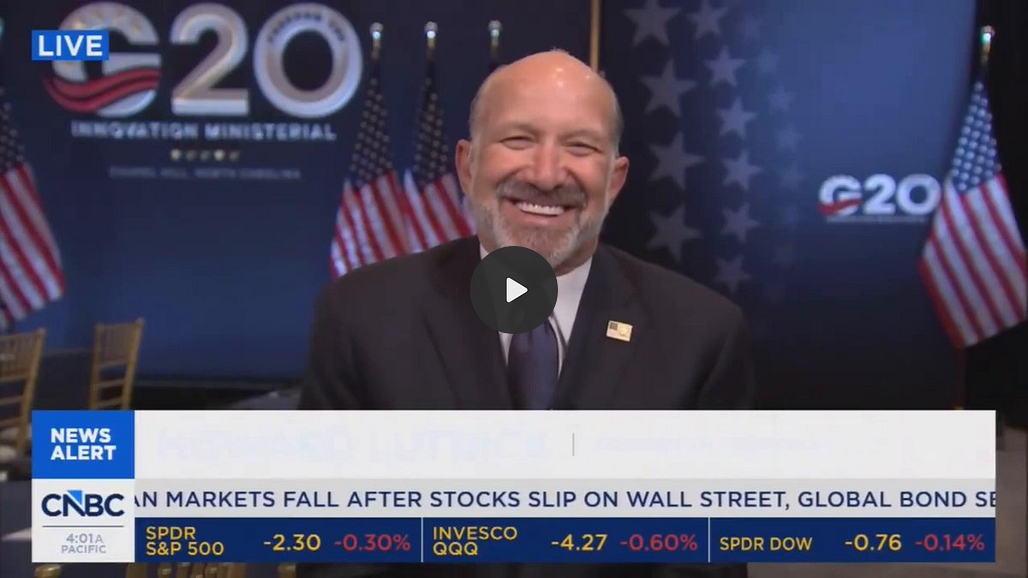
In a separate piece of pro-AI lobbying by the administration, Commerce Secretary Howard Lutnick falsely claimed on CNBC this week that “Data centers don’t use water. This is propaganda by our adversaries to try to slow us down.”
However, as noted by the progressive news website MeidasTouch, Lutnick argued the exact opposite in an interview last year, saying, “These AI things suck water. They need water.”

Argentine president’s relationship with Thiel becomes liability
While far-right billionaire Peter Thiel’s newfound infatuation with Argentina was inspired by its arriviste president, Javier Milei, their relationship could hinder the libertarian leader’s odds of reelection.
In an hours-long hearing last week, Argentine opposition lawmakers pointed to Thiel as proof that Milei is selling the country out to Big Tech and foreign interests, according to Bloomberg:
Thiel also met with Milei and members of the cabinet earlier this year, just as the libertarian leader began pushing one bill to make it easier for foreigners to purchase Argentine land and another that would allow companies to be run entirely by AI.
Recent surveys of Argentine voters show that Milei’s favorability rating has fallen to its lowest mark since he took office. He is up for reelection in October of next year.
Among world leaders, Milei, a self-avowed “anarcho-capitalist,” most closely aligns with the political ideology that Thiel has spent decades championing. The German-born Thiel, in turn, views Milei’s Argentina as a potential backup country where he could decamp — a contingency plan partly motivated by growing US support for billionaire wealth taxes, per the New York Times.
The billionaire co-founder of PayPal and Palantir has already purchased a Buenos Aires mansion where his family now lives. But Thiel’s home was recently the site of a protest in which Argentines lambasted Palantir, an AI company that helps the US and Israeli governments surveil and “kill” their enemies.
Juan Marino, one of the protest’s organizers and a congressman for the Peronist bloc, suggested that Thiel was steering the world toward a “futuristic dystopia, where technology exterminates humanity.”
Oligarch Roundup
JD Vance, Peter Thiel’s protégé, embraces “antichrist” talking points. Asked whether humanity is living through “the end times,” the vice president told an evangelical podcast host that the antichrist could be “walking among us” already. The comment echoed millenarian warnings promoted by Thiel, who used his wealth and influence to build Vance’s political career. During the same podcast appearance, Vance, a Catholic, said he would be “OK” if he inadvertently brought about “the end times” by “doing as much of God’s work as possible.” (The Independent)
Nurses in Texas call on hospitals to cancel their contracts with Palantir. In Austin last week, members of the National Nurses United union gathered to protest hospitals across the country that pay Palantir to use their data management and analytics tools. “Different hospital systems use their AI technology to the detriment of the nurses and the patients,” said Monica Gonzalez, a local nurse. The protesters, who met outside an investment firm led by Palantir co-founder Joe Lonsdale, also took issue with the company’s role in helping the US government deport migrants and prosecute its wars. (CBS Austin)


Scores of Jewish artists back Mark Ruffalo after Ellisons’ Paramount accused him of using “antisemitic tropes.” Paramount, which is led and owned by the centibillionaire Ellison family, leveled the accusation after Ruffalo criticized the services that Larry Ellison’s tech firm provides the Israeli military. In response, nearly 200 Jewish actors, filmmakers, and other professionals signed an open letter supporting Ruffalo, who they said was the target of an “outrageous smear campaign.” Ruffalo has been one of the more outspoken actors against the Ellisons’ attempt to acquire Warner Bros. Discovery and merge it with Paramount. (The Guardian)
This is terrifying but so important for people to understand how the oligarchs are controlling every aspect of our lives and we are losing freedom and safety every minute.
Thank you for your excellent detailed work.