

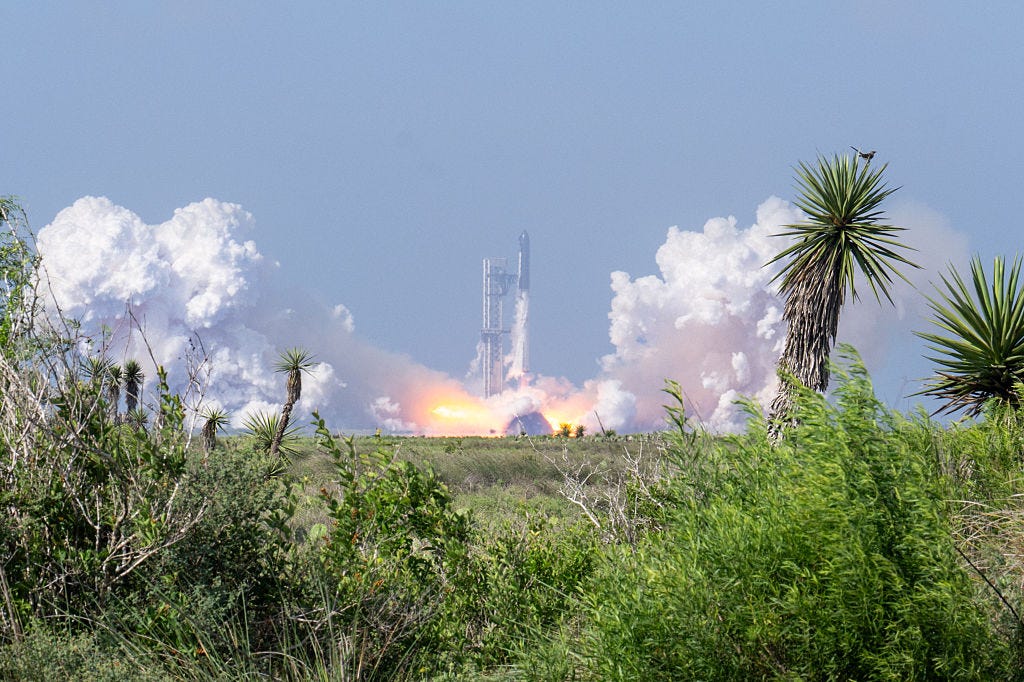
Over the last few weeks, the Trump administration has taken unprecedented actions directly benefiting Elon Musk’s SpaceX, including handing over hundreds of acres of public land from a critical wildlife refuge to the company so it can expand its launch and industrial facilities in Texas.
Despite leaving the White House more than a year ago, the world’s richest man appears to be seeing continued returns from the $290 million he spent underwriting Donald Trump’s 2024 presidential campaign.
Musk’s role as the GOP’s largest benefactor has carried over into the current election cycle. He has given $85 million to Republican or Republican-leaning PACs and funds to influence this year’s midterms, while SpaceX, his rocket, satellite, and artificial intelligence company, is funneling nearly all of its political spending to Republicans.
At the same time, the company has become a favorite of the administration, with SpaceX playing a starring role in Trump’s drive to reorient the government, military, and economy around the AI industry and its technologies.
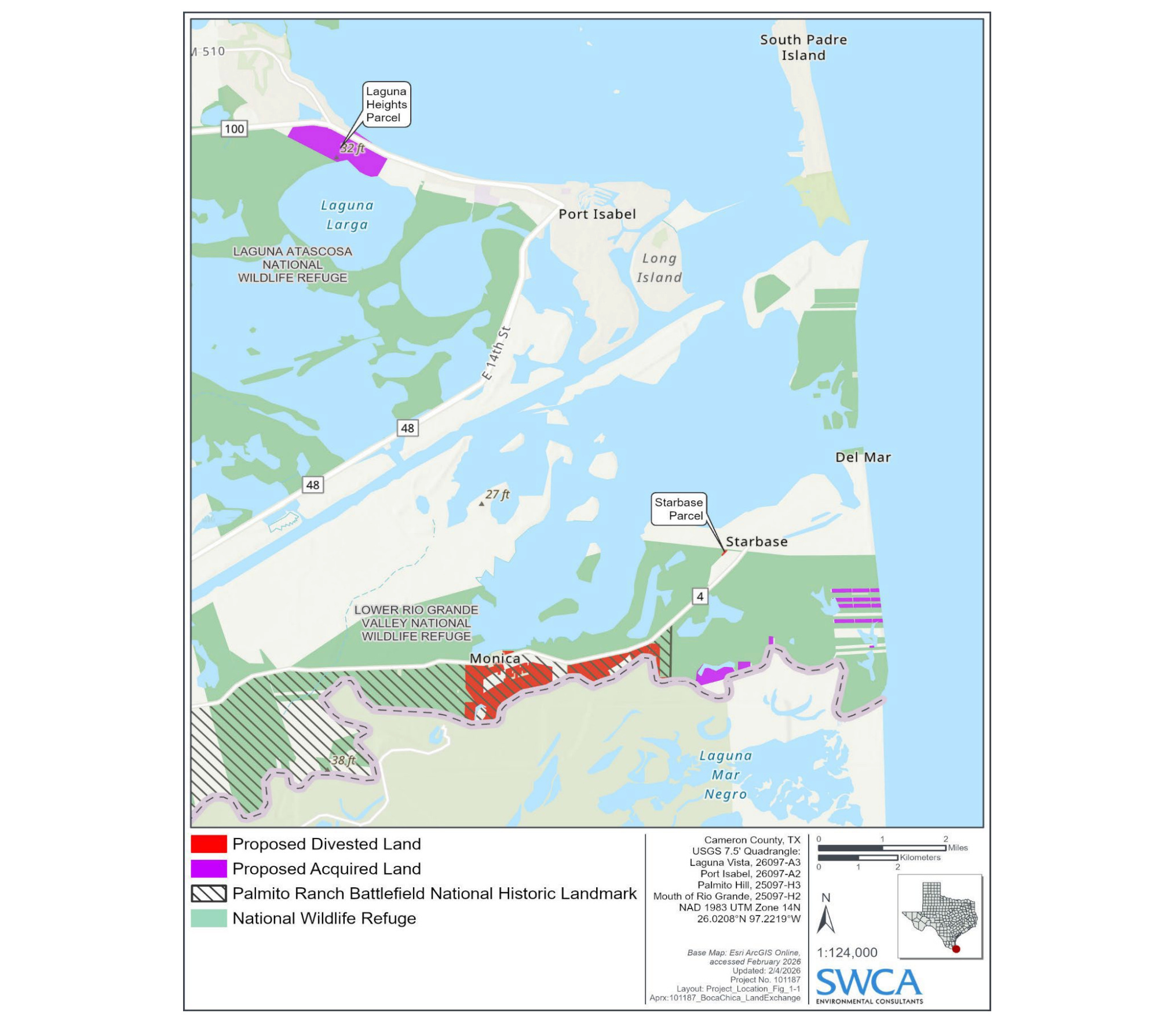
In coastal South Texas, where SpaceX operates its headquarters and its most hazardous launch site, the US Fish and Wildlife Service announced this month that it would grant the company 715 acres of public land from a wildlife refuge that protects federally endangered and threatened species. The same strip of land is part of a historic landmark for the final battle of the Civil War.
The agency’s planning for the deal dates back to the spring of last year, when Musk was leading the White House’s Department of Government Efficiency (DOGE) and one of his deputies was serving in a top-level policy and land management role at the Department of the Interior, which oversees Fish and Wildlife.
Trump’s Department of Justice (DOJ) also assisted SpaceX this month by attempting to neutralize federal air quality law. The extraordinary move would ensure that xAI, a subsidiary of SpaceX, can continue to power its data centers with dozens of polluting, gas-burning turbines in Mississippi. In a filing, the DOJ pushed to dismiss a Clean Air Act lawsuit against SpaceX, arguing that the executive branch — not private citizens — is the only entity that can decide whether corporations are violating the law. The government further defended the company by describing its data centers as “critical to the economy and the Department of War.”
“They’re saying that this land is worth less because it’s already been destroyed by SpaceX”
In its Texas land deal with SpaceX, Fish and Wildlife has agreed to give the company 715 acres within the Lower Rio Grande Valley National Wildlife Refuge, a large, contiguous corridor for multiple federally endangered or threatened species. SpaceX operates a company town in the area called Starbase and plans to use land acquired from Fish and Wildlife to expand its rocket manufacturing facilities and launch sites.
In return, SpaceX has offered to give the public a smaller, disjointed assortment of local parcels. Fish and Wildlife has said the land being offered by the company, totaling 683 acres, would be added to a separate refuge, the Laguna Atascosa National Wildlife Refuge.
But SpaceX’s offer would not satisfy a federal law from 1997 requiring that any exchange of wildlife refuge lands yield a net conservation gain for both the specific refuge in question and the broader National Wildlife Refuge System, explained Laiken Jordahl, a public lands advocate at the Center for Biological Diversity, which is leading a lawsuit to block the deal.
“The sense of entitlement that SpaceX has had in this swap is pretty jaw-dropping,” Jordahl said in an interview with Oligarch Watch. “They’re offering up substantially less acreage which will be added on to a totally different wildlife refuge that is not as important for wildlife. It does not have that critical wildlife connectivity value that the land SpaceX is trying to take over does.”
The information landscape in the United States has reached a crisis point. Billionaires are using social media platforms and media outlets to advance their political and financial interests.
A Trump loyalist just seized control of CBS, CNN, and TikTok’s US operations.
Google paid Trump $25 million to settle a bogus lawsuit.
The Washington Post used editorials to advance the financial interests of owner Jeff Bezos
Meta CEO Mark Zuckerberg installed a Republican operative as head of policy
The only way to fight back is to build up independent media that is free from the influence of billionaires and corporate America.
Although Oligarch Watch has over 50,000 readers, only a small percentage support our work as paid subscribers. If you believe in independent journalism that holds the powerful to account, and can afford $7 a month or $60 per year, please consider becoming a paid subscriber.
Joining the lawsuit are Save RGV, the Carrizo/Comecrudo Nation of Texas, and the South Texas Environmental Justice Network. Filed on June 10 in the US District Court for the District of Columbia, the suit accuses Fish and Wildlife of violating numerous laws in its attempt to rush through the land deal, including the National Wildlife Refuge System Improvement Act of 1997, the National Environmental Policy Act, and the Administrative Procedure Act.
Arrangements to facilitate the exchange began as early as April 2025, when a Fish and Wildlife official discussed using “the most expedited schedule possible” to give SpaceX the land, according to communications obtained by the Center for Biological Diversity. At the time, Musk was working as a top presidential advisor and leading the White House’s DOGE initiative. One of Musk’s DOGE underlings, former oil field services executive Tyler Hassen, was also serving as the Interior Department’s acting assistant secretary for policy, management, and budget, a role that involves overseeing the department’s acquisition and property management. Fish and Wildlife’s land holdings are governed by the Interior Department.
Fish and Wildlife and Hassen did not immediately respond to requests for comment.
The agency’s exchange with SpaceX could have devastating consequences for future private-public land transactions. In an environmental assessment used to justify the deal, Fish and Wildlife suggested that the land it is offering SpaceX has reduced ecological value due to its proximity to the company’s launch and industrial sites. “Basically, they’re saying that this land is worth less because it’s already been destroyed by SpaceX, so, therefore, [SpaceX doesn’t] have to offer up as much land to the government for it to be a fair exchange,” said Jordahl, who noted that he and his colleagues had never come across a similar scenario in US history. “That would set a really scary precedent, where any industry operating on public land or around public land could intentionally degrade that land to lower its value — with the ultimate intent of acquiring it for pennies on the dollar later on.”
The land that SpaceX is looking to acquire contains rare coastal dune ecosystems that run along the Rio Grande and near the river’s mouth. The dense Texas thorn scrub provides habitats for migratory birds and the federally endangered ocelot, a mid-sized wildcat with a striking spotted coat. Researchers last year estimated that there are fewer than 100 wild ocelots in the entire US, all of which live and breed in South Texas.
The refuge is also home to the federally threatened piping plover, a shorebird with an estimated population of less than 8,400. Given that the land degrades a critical habitat for piping plovers, it “would likely be a violation of the Endangered Species Act,” Jordahl said. (A 2024 report found that a successful SpaceX test launch from a pad in the vicinity of the refuge caused the destruction of or damage to eggs in every shorebird nest being monitored by the Coastal Bend Bays & Estuaries Program.)
Along with a chunk of the Lower Rio Grande Valley National Wildlife Refuge, SpaceX would also be given parts of the Palmito Ranch Battlefield, a registered national historic landmark and site of the Civil War’s last battle. The groups suing to block the land transfer have accused the Trump administration of violating the National Historic Preservation Act.
“At this point,” said Jordahl, “we’re hoping a judge will step in and stop this transfer and send SpaceX back to the drawing board… to at least come up with a plan that doesn’t harm the refuge or at least adds some conservation benefit to the refuge as the law requires.”
Last year, Trump’s Federal Aviation Administration authorized SpaceX to conduct 25 annual launches of its 408-foot-tall, experimental Starship rockets from Texas, a five-fold increase from the previous license. With tanks that hold approximately 5,000 metric tons of propellant, failed Starship launches and tests have resulted in explosive blunders that have sent debris flying into parts of Mexico.
To meet its persistent and growing fuel demands, SpaceX plans to begin construction of Starpipe next month. The 16-inch-wide, eight-mile-long natural gas pipeline will run from the Port of Brownsville to its South Texas facility, according to reporting from the Rio Grande Valley Business Journal and Reuters. The company is also looking to drill for natural gas in Texas and plans to build facilities at Starbase to process its rocket propellant, an initiative likely tied to Musk’s goal of increasing the Starship launch cadence to hundreds or thousands per year.
“There’s nothing anyone can do about it”
The Trump administration has also sought to wield the powers of the Departments of Justice and Defense in an unprecedented effort to benefit xAI, a SpaceX subsidiary, by prohibiting American citizens from suing corporations under the Clean Air Act.
Earlier this month, lawyers for the Justice Department filed a motion to intervene in and dismiss a federal lawsuit launched by the NAACP and its Mississippi affiliate against xAI for operating 59 unpermitted gas-burning turbines at its power plant in Southaven, Mississippi. The truck-sized turbines, which help power xAI’s data centers and its Grok large language models, emit tiny particulate pollutants and smog-forming nitrogen oxides linked to increased rates of asthma, respiratory disease, and heart attacks. The power plant is located hundreds of feet from a large working-class neighborhood with parks, churches, and an elementary school.
In its filing, lawyers for the Trump administration argued that local communities have no right to sue a company for violating the Clean Air Act if the federal government opposes their cause. “The Clean Air Act affords the United States primacy over citizen-enforcers when it comes to enforcement discretion,” the DOJ wrote, adding that the NAACP cannot pursue “enforcement action over the United States’ objection.”
Laura Thoms, a lawyer who spent 19 years at the DOJ and now works for Earthjustice, a group representing the NAACP, told MSNOW that she has “never known the government to intervene on behalf of the defendant to argue that enforcement shouldn’t happen at all.”
“They’re saying that when we, the federal government, decide that a company should be able to continue violating for whatever reason, there’s nothing anyone can do about it — not the communities that are impacted by the pollution, not the courts, not even Congress,” Thoms continued.
The DOJ justified its intervention, in part, by claiming that xAI’s Grok models, which have been used to generate child sexual abuse material, nonconsensual deepfake pornography, and Nazi propaganda, are “critical to the economy.” The government arrived at that conclusion by citing Trump’s executive orders that call for enhancing “America’s global AI dominance in order to promote human flourishing” and expanding national energy infrastructure to meet the AI industry’s insatiable demand.
The Pentagon’s AI chief, Cameron Stanley, also submitted a sworn declaration describing xAI’s Grok Gov Model, a proprietary system made for the US government, as essential for “mission-critical operations across Secret and Top-Secret classified networks” and packed with features “found in no other frontier AI model.” He added that the use of Grok for target acquisition enabled the military to “deploy over 2,000 munitions at 2,000 distinct targets within 96 hours” during US strikes on Iran this year. (More than 1,700 Iranian civilians, including hundreds of children, have been killed in the air war waged against it by the US and Israel.)
In another marker of Musk’s lasting gains from his stint in the White House, James Burnham, a former Trump administration lawyer who later served as DOGE’s chief legal advisor, now works as general counsel for xAI. “Very grateful for @TheJusticeDept’s support!” Burnham wrote in a post on X responding to the Trump administration’s effort to dismiss the NAACP suit against xAI.
SpaceX appears confident it will be allowed to continue operating its polluting turbines in the communities forced to live alongside its data centers and power plant. In a regulatory filing ahead of its recent $1.75 trillion initial public offering, the company disclosed plans to spend $2.8 billion acquiring additional gas turbines.
These people are completely devoid of any sense of humanity.
What do you get when you sell your soul to the devil