

Meta, the tech giant with a market capitalization of over $1.8 trillion, is spending heavily this election on obscure state legislative races — eager to defuse what is the biggest regulatory threat to CEO Mark Zuckerberg’s massive gamble on “superintelligence.”
Late last month, Meta gave $1 million to California Leads, its joint, pro-AI super PAC with Google, according to a campaign finance disclosure filed last week. The funds added to the more than $65 million the company had already spread across four political spending vehicles focused on state races.
Three days after Meta’s August 28 contribution, Google, which boasts a market cap of over $4 trillion, poured another $5 million into California Leads, doubling its initial commitment.
The corporate cash injections, which have not been previously reported, came shortly before California Leads spent more than $2.2 million to support four candidates running for seats in the California Legislature.
In one Orange County district, California Leads has spent $1.96 million supporting its approved state Assembly candidate, or about $459,000 more than all contributions to every candidate who ran for the seat in 2024.
That kind of brute-force political spending suggests that Meta and Google — faced with a furious popular backlash against AI technologies and data centers — are willing to do whatever it takes to come out of this unsettled period on top. Meta, which plans to spend as much as $145 billion on AI and other capital projects this year, appears particularly keen on securing its future against regulatory risks. On multiple occasions, Zuckerberg has personally lobbied against proposed AI regulations.
Federal policies that would restrain the development and proliferation of AI models in the US are unlikely in the near term. President Trump has repeatedly come out against such proposals, insisting they would give China an edge in the “AI race.”
But the threat of state action is a real and urgent concern for the industry. Novel regulations passed in one state could inspire similar legislation elsewhere, create new compliance impediments, or pressure AI companies to make comprehensive product changes rather than toil over state-specific versions.
Laws passed in California are particularly consequential. New tech regulations there often trigger nationwide reform, and Meta, Google, and most of the prominent American AI companies are headquartered there.
Meta and Google did not immediately respond to requests for comment.
“Strategic advertising and voter outreach”
As part of its patrons’ effort to stave off state-level regulation, California Leads is focusing its general election spending on tight races, promoting candidates who are more supportive of the AI industry than their opponents.
In the race for State Assembly District 47, the PAC has spent $499,671 this month on independent expenditures supporting Republican incumbent Greg Wallis. He is running against Democratic candidate Leila Namvar, a former union leader endorsed by the California Working Families Party and more than two dozen labor groups.
In May, during the primary, Wallis and Namvar described how they would approach AI regulation while responding to the same candidate questionnaire from the Orange County Register.
“Over-regulate, and the industry moves to Texas,” Wallis said. “Under-regulate, and workers and consumers get hurt. Neither is acceptable, so the framework I work from is use-case specific.” He also argued that California should have “light-touch rules for [AI] research and development” and embrace the technology by funding “AI literacy and retraining programs” for workers.
Namvar responded with a broader regulatory vision. She argued that “Ethical guidelines and oversight boards, including experts, workers, and community representatives, can ensure AI is deployed in ways that support people rather than replace them.”
The race between the two candidates could be close. In the primary, Wallis finished first, receiving just over 48% of the vote. Namvar placed second with 32%, while another Democratic candidate pulled 20%. (In California’s open primary format, the top two vote-getters move on to the general, regardless of party affiliation.)
Meta and Google are seeking to use their virtually unlimited war chests to tip the race in their favor. “We focus on competitive races where additional engagement can make a meaningful difference,” California Leads states on its website.
Elsewhere on the site, the PAC says it uses “strategic advertising and voter outreach” to support candidates who prioritize “innovation,” “economic growth,” and “practical, results-oriented governance.” Its expenditure reports show that much of its cash has gone to political consulting firms that provide phone-based and online outreach urging voters to support the PAC’s favored candidate.
“If these companies leave, we lose jobs”
Other general election races that California Leads has spent on feature dueling Democratic candidates.
Since September 11, it has poured $828,919 into expenditures supporting Sara Hernandez, a moderate running for state Senate in a deep-blue Los Angeles district.
In sharing her vision for AI regulation in the Register’s candidate questionnaire, Hernandez said in May that California should “lead on AI” by pursuing “responsible deployment” that protects workers. “The goal is not to choke off innovation, but to make sure innovation works for Californians instead of happening at their expense,” she added.
Grow California, a PAC funded by tech billionaires Chris Larsen and Tim Draper, has also spent more than $1 million supporting Hernandez, according to campaign finance disclosures.
Her opponent, Sarah Rascón, a progressive with backing from numerous labor groups, answered the same question about AI by writing, “There must be reasonable regulations and safeguards around AI… In addition, we must analyze the need for data privacy protections and ensure that jobs and skills that require analysis and decision-making are not replaced by AI.”
A few miles southeast, in Orange County, the Meta and Google PAC has spent $648,397 this month supporting David Penaloza, a Democrat running for state Assembly. He has said that Californians should take a balanced, non-stifling approach to AI regulation, one that encourages “responsible innovation instead of punishing it.”
“If we overregulate or create an environment that’s too burdensome, companies will leave California and continue growing elsewhere,” he said in the Register’s May candidate questionnaire. “If these companies leave, we lose jobs, we lose accountability, and we lose the ability to shape a responsible regulatory framework.”
His opponent, Jessie Lopez, a Bernie Sanders-endorsed Democrat, used the same forum to raise concerns about companies making their workers “train systems that may eventually replace those same workers.”
Meta was accused of attempting a similar scheme earlier this year, when it required employees to let a software program track almost every move they made on their work computers. The company planned to use the data to train its AI models. But the program paused in June after it exposed private employee data to the entire company.
Lopez added that, if elected, she would support “clear, targeted guardrails” for AI. “California can remain a leader in AI by setting smart, enforceable rules that protect the public while still allowing responsible innovation to grow,” she said. “Strong oversight and economic opportunity should go hand in hand.” (As in the Hernandez versus Rascón race, Larsen and Draper’s Grow California is supporting the same candidate as California Leads. Along with spending $916,000 to boost Penaloza’s candidacy, Grow California has also spent $1.1 million attacking Lopez.)
California Leads began operating last year with $10 million in combined funding from Meta and Google, along with $100,000 from billionaire venture capitalist Ron Conway. It spent approximately $7.66 million in April and May to support the primary campaigns of nine candidates. All but one of its favored candidates clinched the top-two finish needed to advance to a general election.
Meta’s other California PAC sent $3 million back to the company
On August 25, Meta’s other California-specific PAC, Mobilizing Economic Transformation Across (META) California, repaid the company $3 million, according to a September 24 filing. The PAC — which Meta operates and funds exclusively, unlike California Leads — made the reimbursement from the $20 million it received from the company in August of last year. It had nearly $7.6 million in cash on hand as of its latest filing, but has not reported spending to support any candidates during the general election.
It is not clear why Meta is focusing on California Leads at this stage instead of its own PAC. Both PACs funded some of the same candidates during the primaries. From a public relations standpoint, a shared PAC with Google could be beneficial. That way, the candidates Meta supports aren’t as obviously tied to its name or its unpopular CEO. The company is also coming off a string of court losses and settlements related to proven and alleged harms that its social media platforms have inflicted on children.
The shared involvement by Meta and Google has led to some news headlines referring to California Leads as a general “Big Tech” or “Tech-backed” PAC.
There was another quirk in Meta’s recent political spending. Some of the company’s PACs have received money from Meta, only to then turn around and pay the company for ad space on Facebook and Instagram.
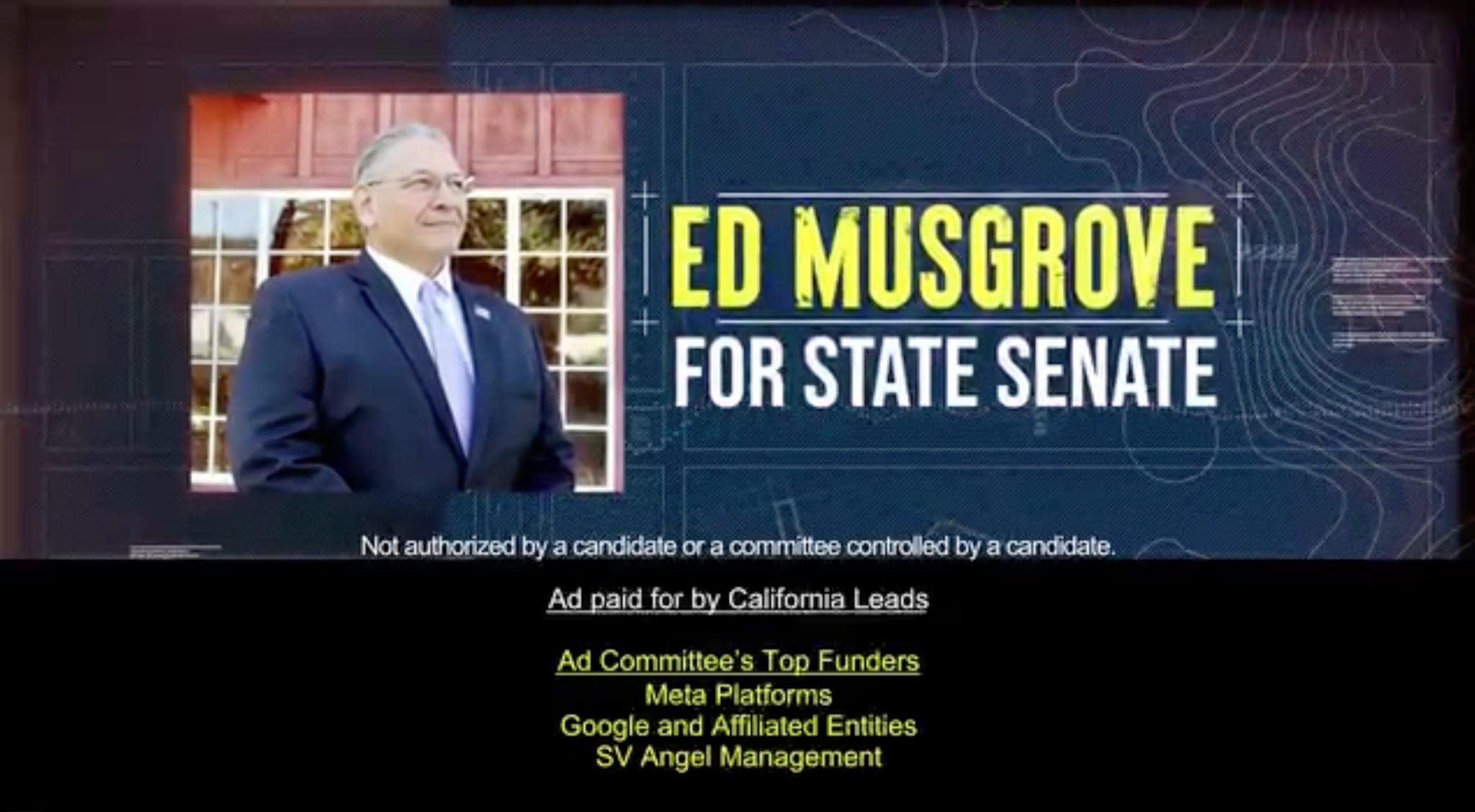
California Leads, for instance, spent $22,923 placing Facebook and Instagram ads in support of Ed Musgrove, a Republican who lost his primary bid for state Senate in June, according to data from the Meta Ad Library.
Two partisan PACs that Meta launched this cycle, the Republican-aligned Forge the Future Project and the Democratic-aligned Making Our Tomorrow, spent $46,922 and $26,982, respectively, on Facebook and Instagram ads.
End Citizens United
Thank you for keeping your keen observations on all this.