

Mark Zuckerberg is a uniquely disliked figure in American life.
As his profile, wealth, and political power have rapidly increased over the past 10 years, his favorability ratings among Republicans, Democrats, and independents have plummeted. This general distrust was on display in two trials last week that found Meta, the Zuckerberg-led parent company of Facebook and Instagram, liable for putting children in harm’s way.
In Los Angeles County Superior Court, the jury in a landmark social media addiction trial determined that Meta was liable for knowingly designing Instagram in ways that led to addictive behavior, causing harm to a young woman who used the social media platform as a child.
The verdict came several weeks after Zuckerberg took the stand, arguing that Meta does not make addictive products and is now in “a better place” when it comes to protecting children from harm.
The jury was not convinced by the centibillionaire’s testimony, with one describing his answers as inconsistent. “That didn’t sit well with us,” the juror told The Wall Street Journal, adding that she was taken aback by how unprepared “the guru” seemed when he took the stand. Another juror told NPR that the verdict was meant to send a message to Meta. “We wanted them to feel it, we wanted them to know this was unacceptable,” a juror said of the Wednesday verdict. (Meta says it plans to file an appeal.)
A day earlier, in Santa Fe, another jury sided against Meta in a case brought by the New Mexico attorney general, accusing the company of enabling child sexual exploitation and misleading the public about the safety of its products.
The twofold reckoning was years in the making.
In 2021, Frances Haugen, a Facebook product manager-turned-whistleblower, revealed that the company had produced studies showing it was aware of the harmful social effects of its platforms, particularly on children. Among the revelations from the Facebook Files was internal research showing that its algorithms had promoted eating disorders and self-harm to impressionable young users. “We make body image issues worse for one in three teen girls,” Facebook researchers wrote in an internal 2019 presentation. Still, a year after that research was shared within the company, Facebook began studying ways to entice more preteens to use its platforms.
These revelations — along with data privacy violations that became public in 2018 — appeared to sully Zuckerberg’s once-bright public reputation. A 2016 poll from Morning Consult had identified him as America’s favorite Silicon Valley executive: 48% of voters viewed Zuckerberg favorably, making him appreciably more popular at the time than peers like Jeff Bezos and Elon Musk. At the time, nearly one-third of respondents noted that they’d never heard of the Facebook founder.
Last year, a survey of U.S. adults conducted by the Pew Research Center found that 94% of respondents were familiar with Zuckerberg. Along with his growing visibility, 67% of respondents said they had an unfavorable view of Zuckerberg, while just 25% viewed him favorably, marking a dramatic swing from the 2016 polling.
In the years between the two surveys, Zuckerberg’s wealth grew by more than $180 billion, and Meta — equipped with data on and access to billions of people worldwide — became an advertising behemoth complete with content algorithms that determine what images, information, and news are seen by hundreds of millions of Americans.
With that growth has come a steady stream of scandals.
“Masculine energy”
In 2018, Zuckerberg appeared repentant as he testified before Congress for the first time. “I started Facebook, I run it, and I’m responsible for what happens here,” he said while profusely apologizing for the company’s role in violating the data privacy of millions of its users. “It’s clear now that we didn’t do enough to prevent these tools from being used for harm,” he continued. “That goes for fake news, foreign interference in elections, and hate speech, as well as developers and data privacy.”
Zuckerberg is no longer apologetic about his company’s social impact.
During an appearance on Joe Rogan’s podcast last year, he suggested that Facebook had been a victim of government overreach by Democrats. “Really, when you think about it, the U.S. government should be defending its companies, not be the tip of the spear attacking its companies,” Zuckerberg grumbled. He also accused the Biden administration of having bullied Meta into censoring posts criticizing COVID-19 vaccines and said he no longer believed that disinformation on Facebook had played a significant role in the 2016 presidential election.
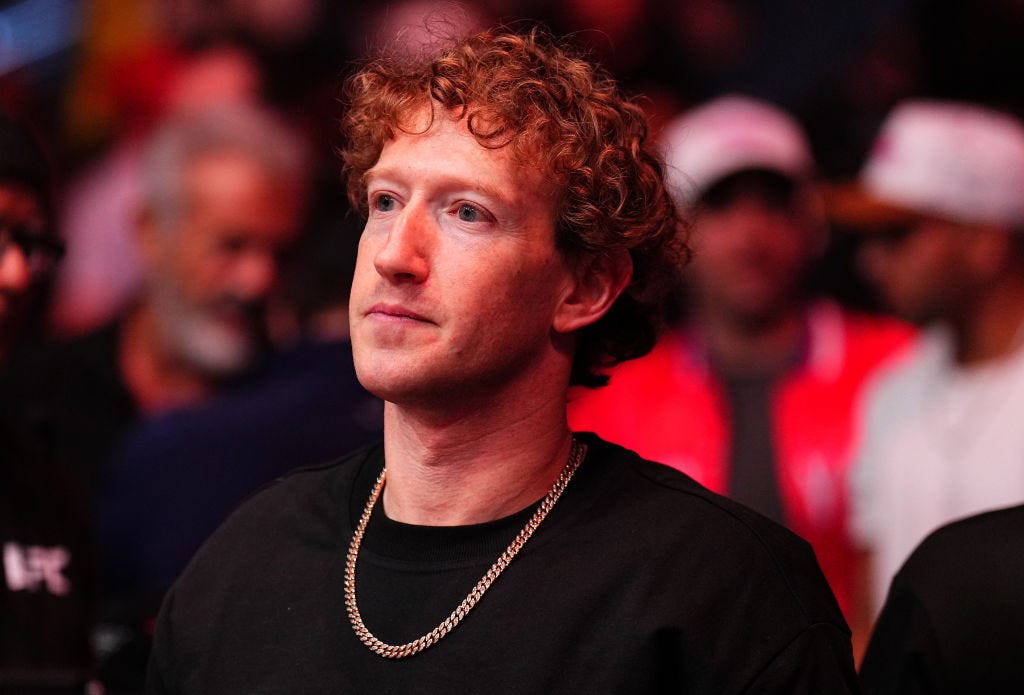
Zuckerberg, 41, also grew out his hair and began wearing trendy luxury t-shirts, a $900,000 watch, and gold chains.
The comments were a snapshot of his retreat from the liberal social ideals that he had spent years emphasizing during Barack Obama’s presidency. Shortly after Donald Trump’s 2024 election, Zuckerberg terminated Meta’s independent fact-checker program and its diversity, equity, and inclusion programs. During the Rogan interview, he also suggested that Meta would embrace a more “masculine energy,” bemoaning that “the corporate world is pretty culturally neutered.”
While Zuckerberg has fostered a friendly and mutually beneficial relationship with Trump this time around, his political shapeshifting has not fully convinced conservatives. The Pew survey last year — taken after Zuckerberg attended Trump’s inauguration — found that 60% of Republicans viewed him unfavorably. That was less than the 76% of Democrats who had an unfavorable view of Zuckerberg. But he was still 26 points underwater with Republicans, indicating that he lacks a strong political support base.
Perhaps sensing this vulnerability, elected officials from both parties have shown an increasing willingness to target Meta with lawsuits and legislation that could hurt its bottom line.
In New Mexico, the lawsuit against Meta was brought by Raul Torrez, the state’s Democratic attorney general. “This was a dangerous product that has been intentionally designed to be addictive,” Torrez told Politico following a jury decision ordering Meta to pay $375 million in damages for endangering children and misleading the public. “It has been intentionally marketed to young people. While [Meta] was well aware of the way in which the features that were built into the product put kids at risk, they weren’t honest with the public… Profit always got the vote from senior executives inside the company, including Mr. Zuckerberg.” No state prosecutor had previously won a ruling arguing that the design of a social media platform itself caused harm to children.
A “helpful respite from the real world”
The New Mexico and Los Angeles trials came on the heels of a years-long effort by red and blue states alike to enact laws restricting children’s use of social media. Some of the laws, including those in Utah, California, and New York, seek to prevent companies like Meta from using addictive algorithms that target children. A number of states have also passed measures that would require parental consent for child users and give parents greater ability to sue social media companies. Many of the laws remain mired in court challenges.
At the federal level, Senators Ted Cruz (R-TX) and Brian Schatz (D-HI) have introduced a bill to prohibit children under 13 from using social media. Some polling indicates that a majority of Americans would support such a move. In late 2024, shortly after Australia passed a law banning children under 16 from social media platforms, a Quinnipiac University poll found that 59% of American voters would support a similar law in the U.S., including 65% of Republicans, 58% of Democrats, and 62% of independents. The notion was polarizing, though, with 31% of respondents saying they would oppose such a law.
Meta, meanwhile, has attempted to protect itself by going on the offensive, spending tens of millions of dollars on lobbying efforts while also seeking to deflect blame.
In the Los Angeles social media addiction trial, lawyers for the company argued that the 20-year-old plaintiff, known as KGM, developed mental health problems due to a poor relationship with her mother and a turbulent home life. They advanced this argument by citing social media posts KGM made as a child and documents from her time in therapy. Meta’s public relations team also played a role by sending “reporters repeated updates from the trial and quotes from testimony that highlighted her familial issues,” according to The Guardian. “Far from causing harm, they alleged that Instagram offered a helpful respite from the real world,” the outlet reported.
But the jury did not find the narrative to be convincing. It found that Meta was liable for $4.2 million in damages to KGM due to its knowingly addictive design features, including its endless, slot-machine-like churn of targeted content. The jury also pointed to harms caused by Meta’s in-app beauty filters, which can show users instantly altered versions of their own face with whiter teeth and smoother, clearer skin.
After the Los Angeles verdict, a Meta spokesperson stated that “teen mental health is profoundly complex and cannot be linked to a single app.”
I find it interesting that this "man" has 3 kids and is married to a PEDIATRICIAN.....
After the birth of his first child, Zuckerburg and his wife were supposedly going to do as Bill and Melinda Gates did and arrange to give away the fortune they were making. Clearly, that was posturing and trying to get in on the publicity. He is all about expediency and damned be the ethics and morality.